 Architect

- Chapter
- Chapter 1 — Distributed Systems
- Prerequisites
- Volume II (architecture styles)
- You will be able to
- Define a distributed system precisely, identify its nodes and communication links, explain how message passing differs from local calls, reason about independent failures, recognise everyday distributed systems in Java/Spring estates, and apply the fallacies of distributed computing as a design checklist
- Covers
- Multiple nodes; Network communication; Independent failures
On this page
- 1. Concept / Definition
- 2. Why It Exists
- 3. Core Concepts
- 4. How It Works Internally — Single Machine vs Distributed
- 4A. Deep Dive — The Fallacies as a Design Checklist
- 5. APIs / Features / Syntax
- 6. Practical Examples
- 7. Common Problems & Mistakes
- 8. Performance & Production Considerations
- 9. Architecture & Design Considerations
- 10. Interview Questions & Answers
1Concept / Definition
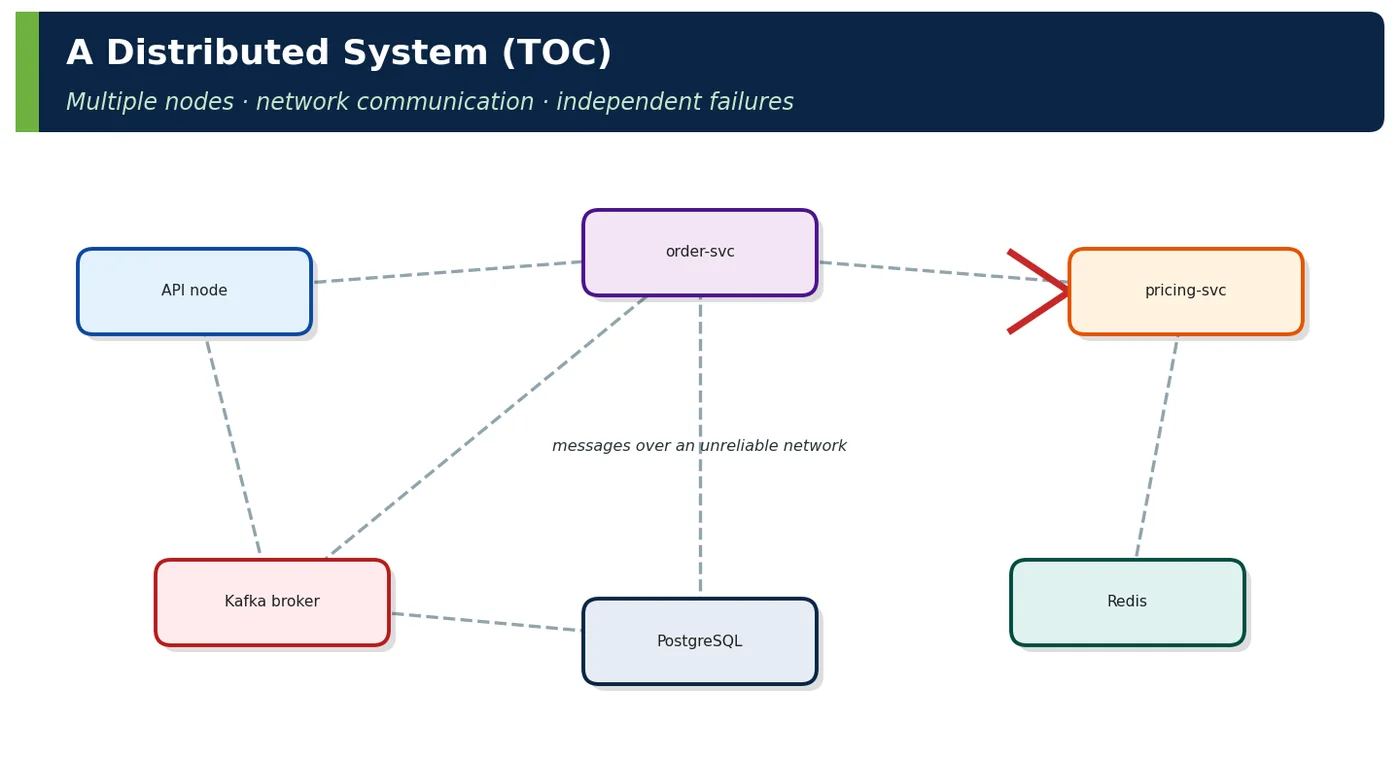
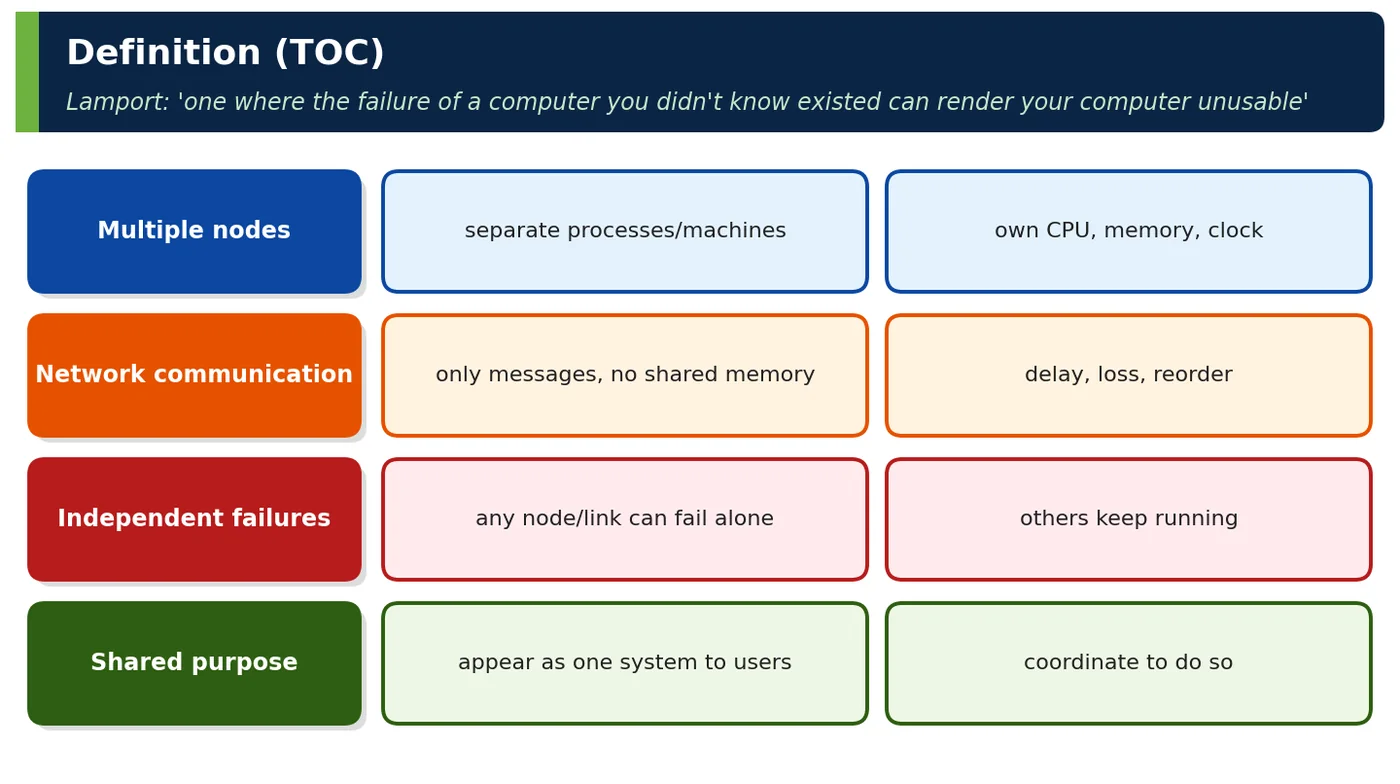
A distributed system is a collection of independent computing nodes that cooperate by exchanging messages over a network to provide a service, where each node can fail independently of the others — yet users should experience it as one coherent system.
| TOC property | Definition |
|---|---|
| Multiple nodes | Separate processes, usually on separate machines, each with its own CPU, memory, storage and clock; no node has a complete, instantaneous view of the others |
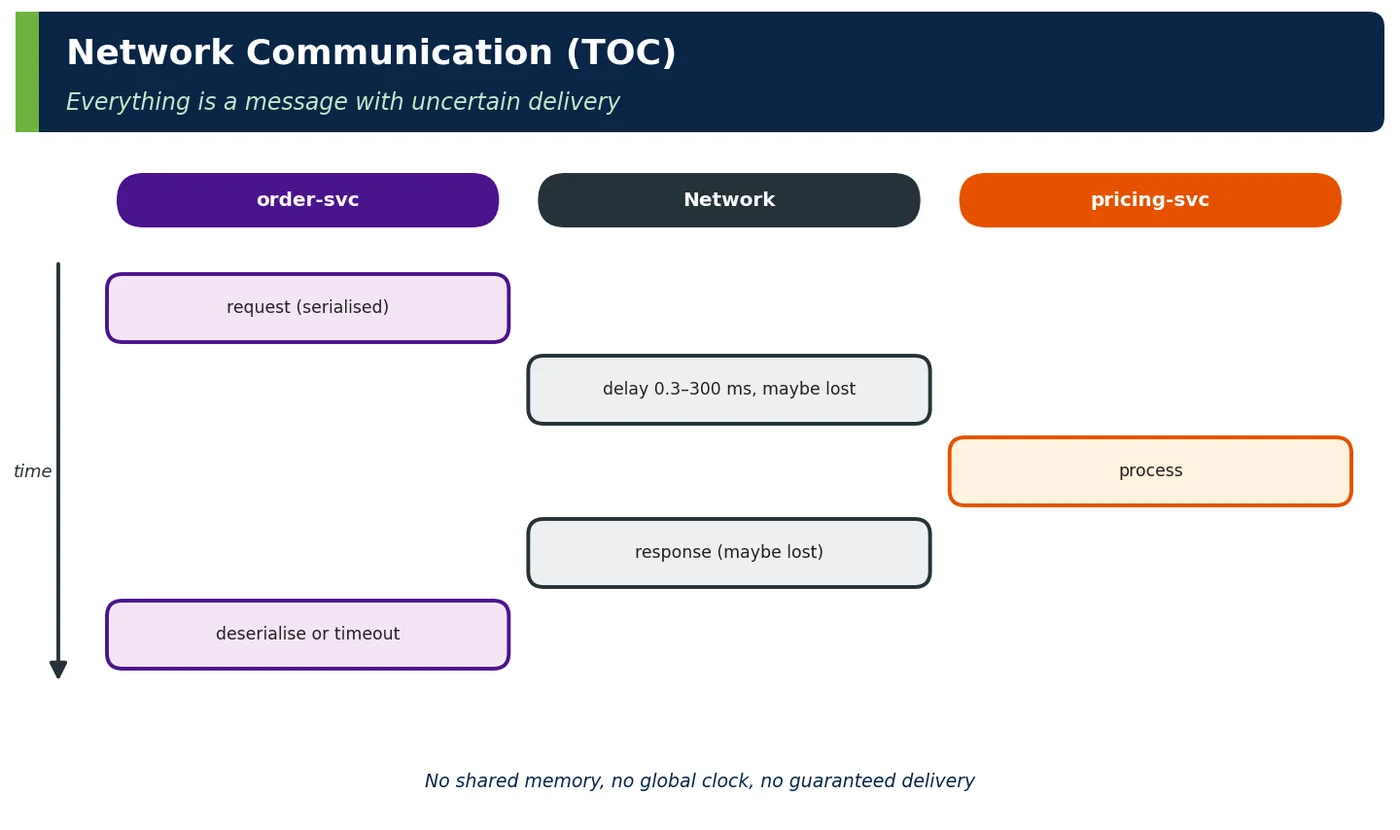
| Network communication | Nodes interact only by sending messages over a network; there is no shared memory, delivery is not guaranteed and delays are variable and unbounded |
| Independent failures | Any node or link can crash, slow down or become unreachable while the rest continue running, so the system is frequently in a partially failed state |
2Why It Exists
We distribute to scale, to survive failures, to be close to users and to respect organisational boundaries (Topic 1.2). The price is that the comfortable guarantees of a single process — shared memory, one clock, all-or-nothing failure — disappear.
3Core Concepts
3.1 Multiple nodes
| Node type (ShopNow) | Count | Own state |
|---|---|---|
| checkout-svc pods | 6 | in-memory caches, connection pools |
| PostgreSQL primary + replicas | 3 | data, WAL position |
| Kafka brokers | 3 | partitions, offsets |
| Redis cluster nodes | 6 | sessions |
| Kubernetes nodes | 12 | pods, kubelet state |
| Node characteristic | Consequence |
|---|---|
| Own memory | State must be communicated, not shared |
| Own clock | Timestamps from different nodes disagree |
| Own lifecycle | Nodes restart, scale, move independently |
| Partial view | Each node knows others only via messages |
3.2 Network communication
// A remote call looks like a method call — but it isn't one
RestClient pricing = RestClient.builder()
        .baseUrl("http://pricing-svc")
        .requestFactory(new JdkClientHttpRequestFactory(HttpClient.newBuilder()
                .connectTimeout(Duration.ofMillis(300)).build()))
        .build();

PriceQuote quote = pricing.post().uri("/quotes")
        .body(new QuoteRequest(sku, qty))
        .retrieve()
.body(PriceQuote.class); // may be slow, fail, or never return without timeouts| Local call | Remote call |
|---|---|
| Nanoseconds | Milliseconds to seconds |
| Never lost | May be lost in either direction |
| Exceptions are local and precise | Timeouts leave the outcome unknown |
| Objects passed by reference | Data serialised and copied |
| Same version of code | Caller and callee versions differ |
3.3 Independent failures
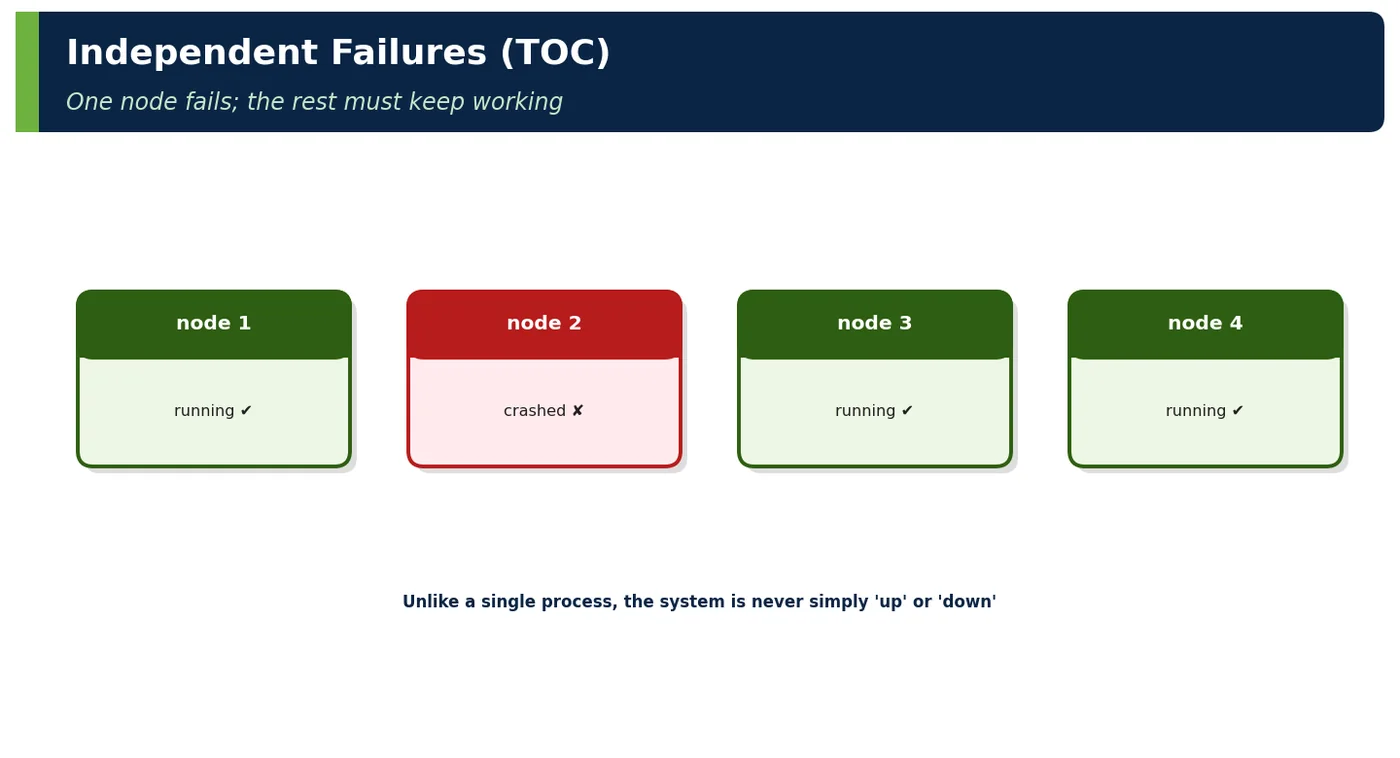
| Failure | Effect on others |
|---|---|
| Pod OOM-killed | Requests in flight fail; others continue |
| Replica lagging | Stale reads for some clients |
| Broker down | Partitions fail over; producers retry |
| AZ network issue | Part of the fleet unreachable |
| Slow GC pause | Node looks dead, then returns |
4How It Works Internally — Single Machine vs Distributed

| Guarantee in one process | In a distributed system |
|---|---|
| Shared memory consistency | Replicas and caches may disagree |
| Total order of events | No global order without coordination |
| Single clock | Clock skew and drift |
| Failure is total | Failure is partial and ambiguous |
| Transactions via DB | Transactions across nodes are hard (Ch 8) |
4ADeep Dive — The Fallacies as a Design Checklist
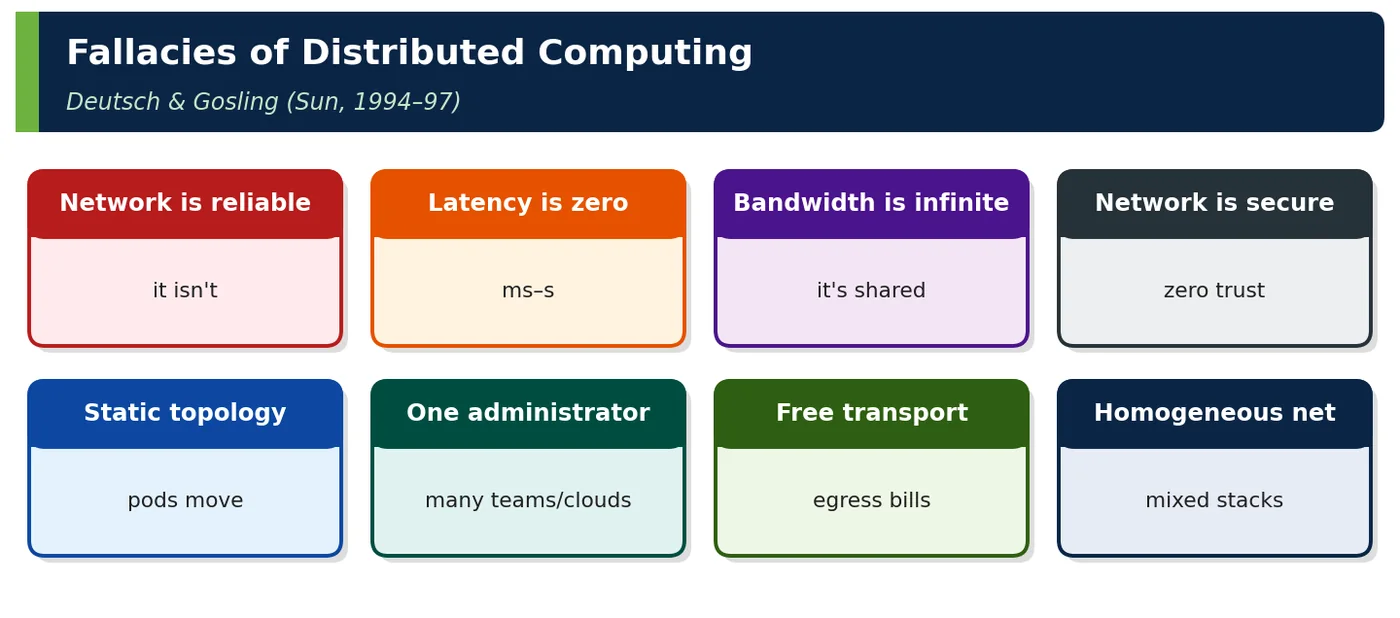
| Fallacy | Design response in Java/Spring |
|---|---|
| Network is reliable | Timeouts, retries with idempotency, circuit breakers |
| Latency is zero | Batch calls, avoid chatty APIs, caches |
| Bandwidth is infinite | Pagination, compression, projections |
| Network is secure | mTLS, zero trust, OAuth2 tokens |
| Topology doesn't change | Service discovery, DNS TTLs, K8s Services |
| One administrator | Contracts, SLOs, runbooks across teams |
| Transport cost is zero | Watch cross-AZ/region egress costs |
| Network is homogeneous | Standard protocols (HTTP, gRPC, Kafka) |
5APIs / Features / Syntax
| Concern | Tooling |
|---|---|
| Remote calls | RestClient, HttpClient, gRPC-Java, Spring Kafka |
| Discovery | Kubernetes Services/DNS, Spring Cloud Kubernetes |
| Resilience | Resilience4j (timeout, retry, circuit breaker, bulkhead) |
| Observability | OpenTelemetry traces across nodes, Micrometer |
| Cluster state | Kubernetes API, Kafka AdminClient, pg_stat_replication |
6Practical Examples
6.1 "It's just a Spring Boot app"
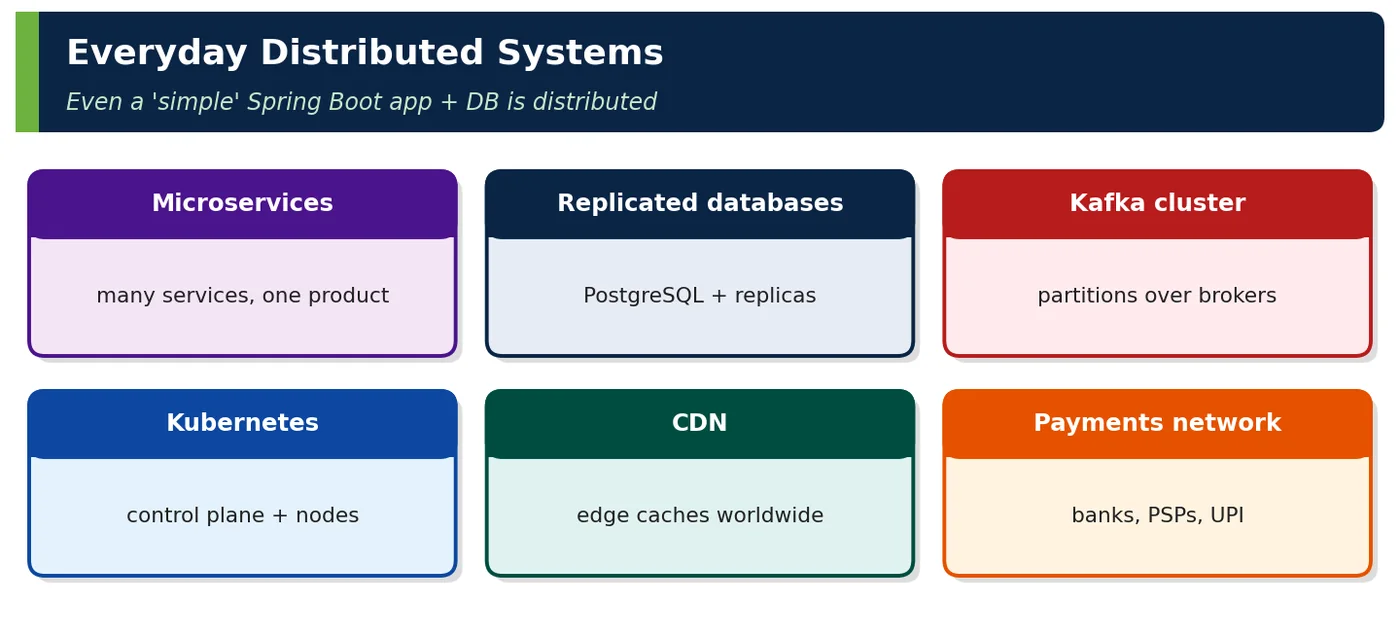
A team insisted their system wasn't distributed: one Spring Boot service with PostgreSQL. A network blip between the app and the database left transactions in unknown state and exhausted the connection pool. The app + DB pair is a distributed system.
6.2 Hidden node
An internal feature-flag service nobody considered critical went down; every service's startup blocked waiting for flags. Lamport's definition in action — the failure of a computer they didn't know mattered.
6.3 Worked example — inventory nodes and links
| Link | Protocol | Failure impact |
|---|---|---|
| checkout → pricing | HTTP | Can't quote |
| checkout → PostgreSQL | JDBC | Can't save orders |
| checkout → Kafka | Kafka protocol | Events delayed |
Scenario. ShopNow's checkout service failed in a different way during each incident, and the on-call engineers had no shared picture of what it depended on.
Walkthrough. The team listed every network link from checkout, with its protocol and the user-visible impact if it failed. Pricing over HTTP: checkout cannot quote prices. PostgreSQL over JDBC: orders cannot be saved. Kafka: events are not published, so downstream systems fall behind. Each row then got an owner, a timeout and a planned behaviour, such as using cached prices or buffering events in an outbox.
Result. The inventory became the basis of the service's runbook, and the next incident was diagnosed by checking the failing link in the table rather than by guesswork.
Takeaway. Start reasoning about a distributed system by inventorying its nodes and links and the impact of each failure. You cannot design for failures you have not listed.
6.4 Worked example — local vs remote latency
| Operation | Time |
|---|---|
| In-memory method call | ~10 ns |
| Same-AZ HTTP call | ~1 ms |
| Cross-region call | ~120 ms |
Scenario. A developer split a hot code path into two services and was surprised that a page which used to load in 50 ms now took over a second.
Walkthrough. The numbers explain it. An in-memory method call takes around 10 nanoseconds; an HTTP call within the same availability zone takes around a millisecond, about 100,000 times longer; a cross-region call takes around 120 ms. The page made 20 calls that used to be in-memory, so even at the best case it added 20 ms of pure network time, and with serialisation, connection set-up and retries it added far more.
Result. The team merged the chatty calls back into one coarse-grained API returning everything the page needed, and latency fell to 70 ms.
Takeaway. Remote calls are orders of magnitude slower than local calls. Design remote interfaces to be coarse-grained, and keep chatty interactions inside one process.
6.5 Worked example — timeouts everywhere
spring:
  http:
    client:
      connect-timeout: 300ms
      read-timeout: 1s
Scenario. ShopNow's checkout used Spring's HTTP client with default settings. When the pricing service hung during a deployment, every checkout thread waited indefinitely and the checkout service stopped responding.
Walkthrough. Every remote call needs explicit limits. The configuration sets a connection timeout of 300 ms, so unreachable hosts fail quickly, and a read timeout of 1 second, so hung responses are abandoned. Callers then handle the failure with a fallback, a retry with back-off or an error, instead of waiting forever. The same discipline applies to database, cache and broker clients.
Result. During the next pricing deployment problem, checkout returned cached prices within a second and stayed available, while the pricing team fixed their release.
Takeaway. Never rely on default timeouts. Set connection and read timeouts on every client based on the caller's latency budget, and define what happens when they fire.
6.6 Worked example — serialisation boundary
| Local | Remote |
|---|---|
Pass Order object | Send JSON/Avro representation |
Scenario. A developer extracted pricing from the monolith but kept passing Order objects to it, expecting changes pricing made to the order to appear in checkout, as they had in-process.
Walkthrough. Across a network there are no shared object references. Checkout sends a representation of the order, such as JSON or Avro, and pricing works on its own copy. Any change pricing makes stays in its copy unless it is returned explicitly. The interface was redesigned to send exactly the data pricing needs and to return a quote, which checkout applies to its own order.
Result. Bugs caused by expecting shared state disappeared, and the contract between the services became explicit and much smaller.
Takeaway. Remote interfaces exchange copies, not references. Design them around explicit requests and results, and never assume that a callee's changes are visible to the caller.
6.7 Worked example — version skew
| Caller | Callee |
|---|---|
| checkout v42 | pricing v17 and v18 during rollout |
Scenario. During a rolling deployment of pricing from version 17 to 18, about half of checkout's calls failed for a few minutes, and then everything recovered.
Walkthrough. In a distributed system, different versions run side by side during every rollout. Checkout version 42 was calling both pricing v17 and v18. Version 18 had renamed a response field, so calls routed to new pods failed until the rollout finished. The fix was to make every change backward compatible: add the new field, keep the old one until all consumers migrate, and test compatibility in the pipeline.
// Tolerant reader on the consumer side
@JsonIgnoreProperties(ignoreUnknown = true)
record QuoteResponse(BigDecimal total, @JsonAlias("amount") BigDecimal price) { }
Result. Later rollouts caused no errors, because providers stayed compatible and consumers ignored unknown fields.
Takeaway. Assume mixed versions are always running. Contracts must tolerate both old and new versions during rollouts, and consumers should be tolerant readers.
6.8 Worked example — partial state
| Moment | State |
|---|---|
| Deploy in progress | 3 pods old, 3 pods new |
Scenario. A support engineer asked which version of the order service was running in production. The honest answer during a deployment was "both".
Walkthrough. During a rolling deployment, three pods run the old version and three the new one, so requests may be handled by either. Database migrations, caches and messages in flight may also reflect either version. There is never a single system version during change, and sometimes not between changes either, if a rollout stalls.
Result. The team added the application version to logs, traces and response headers, so every incident report showed which version handled each request, and investigations stopped assuming a single version.
Takeaway. Design and operate for partial state: mixed versions, half-applied migrations and in-flight messages are normal. Make versions visible in telemetry.
6.9 Worked example — node identity
| Identity | Stability |
|---|---|
| Pod IP | Ephemeral |
| Service DNS name | Stable |
Scenario. A batch job called the inventory service using a pod's IP address copied from a dashboard. It worked until the pod was rescheduled the next morning.
Walkthrough. Pod IP addresses are ephemeral: pods are replaced on every deployment, scale-in or node failure. Service DNS names, such as inventory.shop.svc.cluster.local, are stable and resolve to the current healthy pods behind a Kubernetes Service. Clients should address services, not individual nodes, and let the platform handle load balancing and discovery.
Result. The job was changed to use the service name and has run without failures since, through dozens of redeployments.
Takeaway. Address services by stable names and let the platform route to current instances. Anything that hard-codes node identities will break in a dynamic environment.
6.10 Worked example — one request, many nodes
| Hop | Node |
|---|---|
| 1 | API gateway |
| 2 | checkout pod |
| 3 | pricing pod |
| 4 | PostgreSQL |
| 5 | Kafka broker |
Scenario. A product manager asked why clicking "Place order" could fail when "the server" was up.
Walkthrough. Tracing one click showed it touched five nodes: the API gateway, a checkout pod, a pricing pod, the PostgreSQL primary and a Kafka broker. Each hop is a separate process on separate infrastructure with its own failure modes, and the request succeeds only if every required hop succeeds within its timeout.
Result. Seeing the full path changed the discussion from "is the server up?" to which hops are essential, which can degrade gracefully and which need redundancy.
Takeaway. A single user action usually spans many nodes. Map the path of key requests so availability and latency can be reasoned about hop by hop.
6.11 Worked example — tracing the path
| Tool | Output |
|---|---|
| OpenTelemetry | Span per hop with timing |
Scenario. Checkout latency rose from 300 to 900 ms at p99, and three teams each believed their service was not the cause.
Walkthrough. OpenTelemetry instrumentation produces a span for each hop with its timing, linked by a trace ID carried in the traceparent header. Viewing a slow trace showed that the pricing span took 600 ms, of which most was spent waiting for a database connection from an undersized pool.
management:
  tracing:
    sampling:
      probability: 0.1     # 10% of requests traced
  otlp:
    tracing:
      endpoint: http://otel-collector:4318/v1/traces
Result. Pricing increased its pool size and the p99 returned to normal the same day, without further debate.
Takeaway. Make distribution visible with distributed tracing. In a system of many nodes, traces replace guesswork with evidence.
6.12 Worked example — independent failure matrix
| Component down | User impact |
|---|---|
| Recommendations | None (fallback) |
| Payments | Checkout blocked |
Scenario. ShopNow's leadership asked what would happen to customers if each service went down, but nobody could answer for every component.
Walkthrough. The team built a matrix of components and user impact. If recommendations is down, there is no impact because the product page falls back to no recommendations. If payments is down, checkout is blocked, which is critical. Building the matrix also exposed a surprise: the review service, considered non-critical, was called synchronously during checkout and could block orders.
Result. The review call was moved off the checkout path, and the matrix now drives which services need the highest availability targets and which need fallbacks.
Takeaway. Know how each dependency's failure affects users. Independent failures are only harmless if callers are designed to tolerate them.
6.13 Worked example — the database is remote
| Assumption | Reality |
|---|---|
| "DB call can't fail mid-transaction" | Connection can reset |
Scenario. Under load, ShopNow's order service occasionally failed with "connection reset" errors from the database, and the code treated these as fatal, losing customer orders.
Walkthrough. The database is a remote node, and connections can break mid-transaction because of network blips, failovers or idle-connection limits. For idempotent operations and transient error codes, the application should retry the whole transaction. The service was changed to retry transactions on specific transient SQL states, with a limit and back-off.
@Retryable(retryFor = TransientDataAccessException.class,
           maxAttempts = 3, backoff = @Backoff(delay = 100, multiplier = 2))
@Transactional
public OrderId place(PlaceOrder cmd) { ... }   // idempotent via cmd.requestId()
Result. Database failovers during maintenance now cause a short latency spike instead of lost orders.
Takeaway. Treat the database as a remote dependency that can fail transiently. Retry whole transactions for transient errors, but only when the operation is idempotent.
6.14 Worked example — clocks
| Node | Clock offset |
|---|---|
| pod A | +12 ms |
| pod B | −35 ms |
Scenario. An audit report ordered events by timestamp across services and showed a payment captured before the order was placed, which alarmed the auditors.
Walkthrough. Each node has its own clock, and even with NTP, clocks differ by milliseconds and drift. Pod A was 12 ms ahead and pod B 35 ms behind, so events a few milliseconds apart could appear in the wrong order. Timestamps from different nodes are only approximately comparable.
Result. The report was changed to order events by their causal relationship, using the order's version and event sequence numbers, while timestamps are shown for information only.
Takeaway. Do not rely on wall-clock timestamps from different nodes to determine order. Use sequence numbers, versions or causal links when order matters.
6.15 Worked example — message loss handling
| Layer | Mechanism |
|---|---|
| TCP | Retransmission |
| Application | Retries + idempotency keys |
Scenario. A webhook to a logistics partner was sometimes received twice, and sometimes not at all, even though the network uses TCP, which "guarantees delivery".
Walkthrough. TCP retransmits lost packets within one connection, but it cannot help when a connection fails after the request was sent and before the response arrived. The caller does not know whether the request was processed. Recovery must therefore also happen at the application level: retry with the same idempotency key, and have the receiver ignore duplicates.
Result. With idempotency keys and retries, missing deliveries disappeared, and duplicates were harmlessly ignored by the partner.
Takeaway. Network reliability exists at two levels. TCP handles packets; applications must handle lost or uncertain requests with retries and idempotency.
6.16 Worked example — egress cost
| Traffic | Monthly |
|---|---|
| Cross-AZ chatty calls 50 TB | Significant bill |
Scenario. ShopNow's cloud bill showed a large and growing item for data transfer between availability zones, which nobody had budgeted for.
Walkthrough. Chatty services spread across three zones exchanged about 50 TB per month across zone boundaries, and cloud providers charge for cross-zone traffic. The biggest contributors were services fetching full product objects repeatedly instead of caching them, and logging pipelines shipping verbose logs across zones.
Result. Caching, smaller payloads and zone-aware routing for the heaviest flows reduced cross-zone traffic by about 60%, cutting the bill significantly.
Takeaway. Transport is not free. Measure network volume between zones and regions, and treat bandwidth as a cost to design for.
6.17 Worked example — secure links
| Link | Control |
|---|---|
| Service-to-service | mTLS via service mesh |
Scenario. A security review found that ShopNow's services talked to each other over plain HTTP inside the cluster, on the assumption that the internal network was safe.
Walkthrough. The network is not secure by default: a compromised pod could read or alter traffic between services. The team introduced a service mesh that gives every workload a cryptographic identity and encrypts all service-to-service traffic with mutual TLS, with authorisation policies that state which services may call which.
Result. Traffic between services is now encrypted and authenticated without application code changes, and the policies document allowed communication paths.
Takeaway. Do not trust the internal network. Encrypt and authenticate service-to-service traffic, and restrict which services may talk to each other.
6.18 Worked example — design review question
| Question | Purpose |
|---|---|
| "What if this call never returns?" | Surface timeout & fallback design |
Scenario. ShopNow's design reviews often approved integrations that later failed in production because nobody had considered what happens when a call hangs.
Walkthrough. The architecture group added a standard prompt to every review: "What if this call never returns?" For each remote call, the team must state the timeout, what the user sees, whether the operation is retried, and whether it is idempotent.
Result. The prompt surfaced missing timeouts and fallbacks in most new designs, and incidents caused by hanging calls fell sharply within two quarters.
Takeaway. Use a few standard review questions to apply distributed-systems thinking consistently. Simple prompts catch the most common and costly mistakes.
6.19 Worked example — count the fallacies
| Design flaw | Fallacy |
|---|---|
| No timeout on HTTP client | Network reliable |
| 20 calls per page | Latency zero |
Scenario. A new team's design for a product page looked reasonable, but the reviewer quickly found several problems by checking it against the fallacies of distributed computing.
Walkthrough. Each design flaw maps to a fallacy. No timeout on the HTTP client assumes the network is reliable. Twenty sequential calls per page assume latency is zero. Large uncompressed payloads assume bandwidth is infinite. Plain HTTP between services assumes the network is secure. Naming the fallacy makes the flaw easy to explain and fix.
Result. The team added timeouts, aggregated the calls into two, compressed responses and enabled mutual TLS before going live.
Takeaway. Use the fallacies of distributed computing as a review checklist. Most distributed design flaws are one of them in disguise.
6.20 Worked example — minimum distributed setup
| Component | Nodes |
|---|---|
| App (2 pods) + DB (primary + replica) | 4 |
Scenario. A team argued that their small application was not a distributed system, because it was "just a Spring Boot app with a database".
Walkthrough. Even the minimal production set-up has two application pods, a database primary and a replica: four nodes connected by a network, each able to fail independently. Connections can break, the replica can lag, and pods can be replaced at any time. The same concerns as in larger systems already apply.
Result. The team added timeouts, retries for transient database errors and readiness checks, which prevented several outages during later database maintenance.
Takeaway. Almost every production system is already distributed. Apply basic distributed-systems practices from the start, even to small applications.
6.21 Worked example — interview answer
| Property | Answer |
|---|---|
| Nodes | Independent processes |
| Network | Message passing, unreliable |
| Failures | Independent, partial |
Scenario. In interviews, ShopNow asks candidates to explain what makes a system distributed.
How to answer. A strong answer covers three properties. Nodes: the system consists of independent processes on separate machines. Network: they cooperate only by passing messages over an unreliable network with latency, loss and limited bandwidth. Failures: nodes and links fail independently, so parts of the system can fail while others keep running, creating partial failures.
How to finish. Linking these properties to design consequences, such as timeouts, retries, idempotency and observability, and giving a real example shows that the candidate can apply the theory.
Takeaway. Answer with properties and their consequences, illustrated by a real system. That demonstrates understanding beyond a textbook definition.
7Common Problems & Mistakes
- Treating remote calls like local calls.
- No timeouts on clients.
- Ignoring "small" dependencies (config, flags, DNS).
- Assuming one system version.
- Comparing timestamps across nodes naively.
- Believing the fallacies.
8Performance & Production Considerations
| Aspect | Guideline |
|---|---|
| Calls | Timeouts, retries, idempotency |
| Latency | Minimise hops, batch |
| Observability | Distributed tracing |
| Versions | Backward-compatible contracts |
| Security | mTLS, zero trust |
9Architecture & Design Considerations
- Recognise every system with a network hop as distributed.
- Design each call for slow, lost and unknown outcomes.
- Map nodes, links and failure modes explicitly.
- Use the fallacies as a review checklist.
10Interview Questions & Answers
What is a distributed system?
A distributed system is a set of independent nodes, usually processes on separate machines, that cooperate by exchanging messages over a network and appear to their users as one system. Three properties define it: there is no shared memory, so all coordination happens through messages; communication is unreliable and slow compared with local calls; and nodes and links fail independently, so part of the system can fail while the rest keeps running. Examples range from a Spring Boot application with its database to a platform of hundreds of microservices. These properties drive almost every design decision.
Name two fallacies of distributed computing.
The fallacies of distributed computing are eight false assumptions that developers new to distributed systems often make. Two of the most important are "the network is reliable", which leads to missing timeouts, retries and idempotency, and "latency is zero", which leads to chatty designs with many sequential remote calls. The others are that bandwidth is infinite, the network is secure, topology does not change, there is one administrator, transport cost is zero and the network is homogeneous. Each one maps to concrete design mistakes, so the list is useful as a design-review checklist.
How does a remote call differ from a local call?
A remote call is typically thousands of times slower than a local method call, because it crosses the network and involves serialisation. It can fail in ways a local call cannot: the request or response can be lost, and a timeout leaves the outcome unknown, because the callee may or may not have processed the request. Data is copied rather than shared, so changes on one side are not visible on the other. And the caller and callee may run different versions. Remote calls therefore need timeouts, retries with idempotency and versioned contracts.
What are independent failures?
Independent failure means that each node and each network link can fail on its own, while other parts continue running. A database replica can crash while the primary stays up; a network link between two zones can fail while each zone works internally; one pod can run out of memory while others serve traffic. The result is partial failure: the system is neither fully working nor fully down. Designs must detect such failures, for example with timeouts and health checks, and limit their effect with fallbacks, redundancy and isolation so that one failure does not cascade.
Is a Spring Boot app with one PostgreSQL database distributed?
Yes. The application and the database run as separate processes, usually on separate machines, connected by a network. Connections can break, queries can time out, the database can fail over to a replica, and application pods can be restarted independently. In production there are typically several application instances and a replica, making at least four nodes. So the same concerns apply as in larger systems: timeouts, retries for transient errors, connection pool sizing, health checks and handling of partial failures. Recognising this early avoids many production incidents.
Why can't you compare timestamps from different nodes reliably?
Every node has its own hardware clock, and clocks drift. Synchronisation with NTP keeps them close but not identical; differences of milliseconds are normal, and larger jumps occur during resynchronisation or virtual machine pauses. So two events stamped on different nodes may appear in the wrong order if their timestamps are compared, especially when they are close together. When order matters, use mechanisms that do not rely on wall-clock time, such as sequence numbers from a single writer, version numbers on entities, Kafka partition offsets or logical clocks.
How do you apply the fallacies in design reviews?
Use the fallacies as a checklist for every remote interaction in a design. Is there a timeout and a defined behaviour when it fires, and are retries safe because the operation is idempotent? How many calls happen per user request, and can they be aggregated? How large are the payloads? Is the link encrypted and authenticated? How is the target discovered when topology changes? Who owns and operates each component? What does the traffic cost, especially across zones or regions? Recording the answers in the design makes gaps visible early.
How would you explain to stakeholders why distribution adds cost?
Explain that distribution is a trade-off. A single machine offers simple guarantees: fast calls, shared memory and all-or-nothing failure. Distributing a system gives scalability, resilience to individual failures and team independence, but loses those guarantees. To compensate, the organisation must invest in resilience patterns such as timeouts, retries and fallbacks, in observability such as tracing and monitoring, in contract management between teams, and in operational capabilities such as automated deployment and on-call. Those investments are the ongoing cost of the benefits, so distribution should be chosen where the benefits are needed.