 Architect

- Chapter
- Chapter 1 — What Is Software Architecture?
- Prerequisites
- Experience building Java/Spring systems
- You will be able to
- Define software architecture precisely using standard definitions, distinguish architecture from design and from implementation using significance and reversibility, describe a system's static structures (module, component-and-connector, allocation) and dynamic behaviour, recognise architectural decisions hidden in code, and make structure verifiable in Java projects
- Covers
- Definition; Architecture vs design; Architecture vs implementation; Architectural structure; Architectural behavior
On this page
- 1. Concept / Definition
- 2. Why It Exists
- 3. Core Concepts
- 4. How It Works Internally — Significance
- 4A. Deep Dive — Architecture Erosion and Drift
- 5. APIs / Features / Syntax
- 6. Practical Examples
- 7. Common Problems & Mistakes
- 8. Performance & Production Considerations
- 9. Architecture & Design Considerations
- 10. Interview Questions & Answers
1Concept / Definition
Software architecture is the set of significant structures and decisions of a software system: its elements, their relationships and properties, and the principles guiding its design and evolution — significant because they shape quality attributes and are costly to change.

| TOC concept | Definition |
|---|---|
| Definition | The fundamental organisation of a system — elements, relationships, properties and guiding principles — together with the significant decisions that produced it |
| Architecture vs design | Architecture covers system-wide, quality-driven, hard-to-reverse decisions; design covers decisions inside components that are more local and cheaper to change |
| Architecture vs implementation | Implementation is the realisation in code; architecture constrains it but is not the code itself — though architecture must be visible and enforced in the code |
| Architectural structure | The static organisation: modules and dependencies, runtime components and connectors, and allocation to infrastructure and teams |
| Architectural behavior | The dynamic interplay of elements at runtime: interactions, sequencing, concurrency, failure handling and emergent quality properties |
2Why It Exists
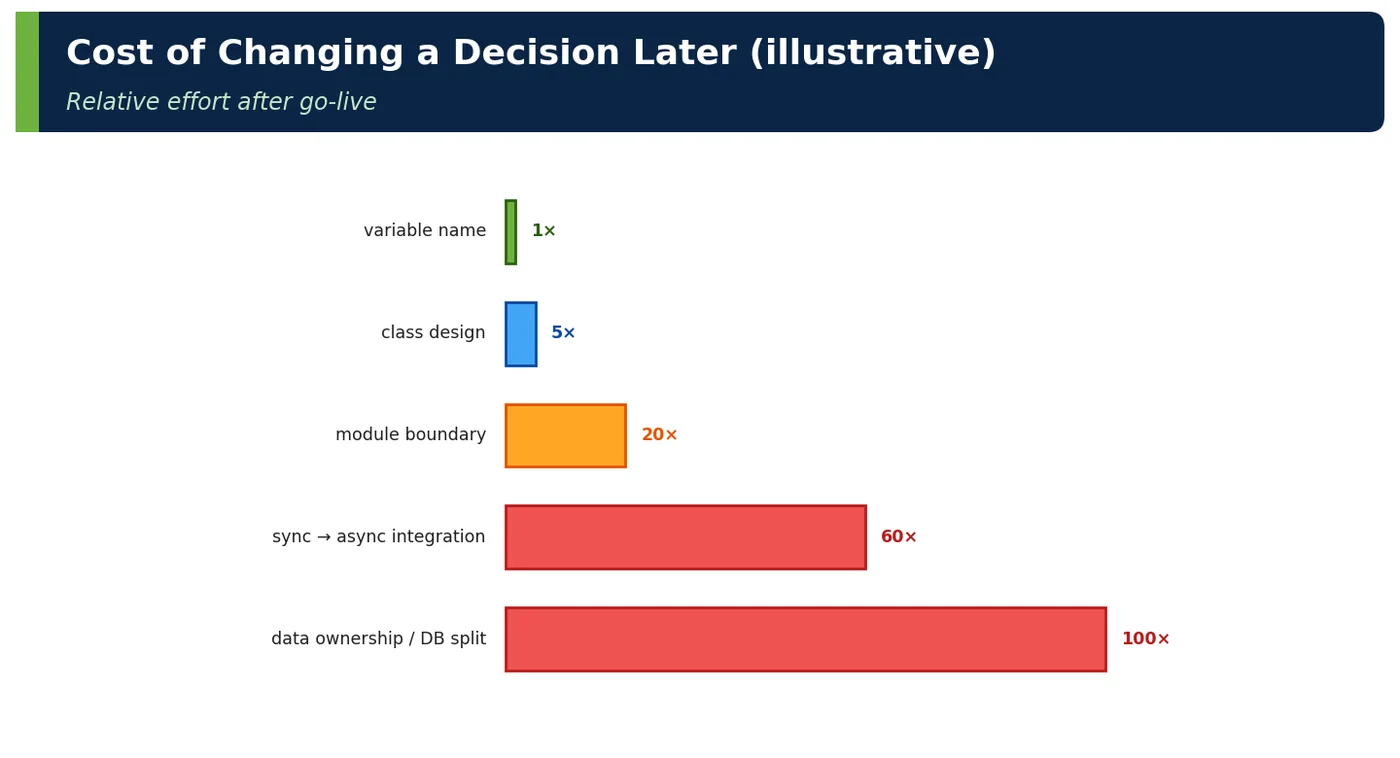
Systems too large for one person's head need a shared, deliberate organisation. Without it, structure emerges accidentally from thousands of local decisions, and qualities such as performance, availability and modifiability become unpredictable. Architecture makes the important decisions explicit, early enough to matter and visible enough to be governed.
3Core Concepts
3.1 Definition
| Definition source | Emphasis |
|---|---|
| ISO/IEC/IEEE 42010 | Fundamental concepts/properties in its environment, embodied in elements, relationships and principles |
| Bass, Clements, Kazman | Set of structures needed to reason about the system |
| Booch | Significant design decisions, measured by cost of change |
| Fowler / Johnson | Shared understanding of the important stuff |
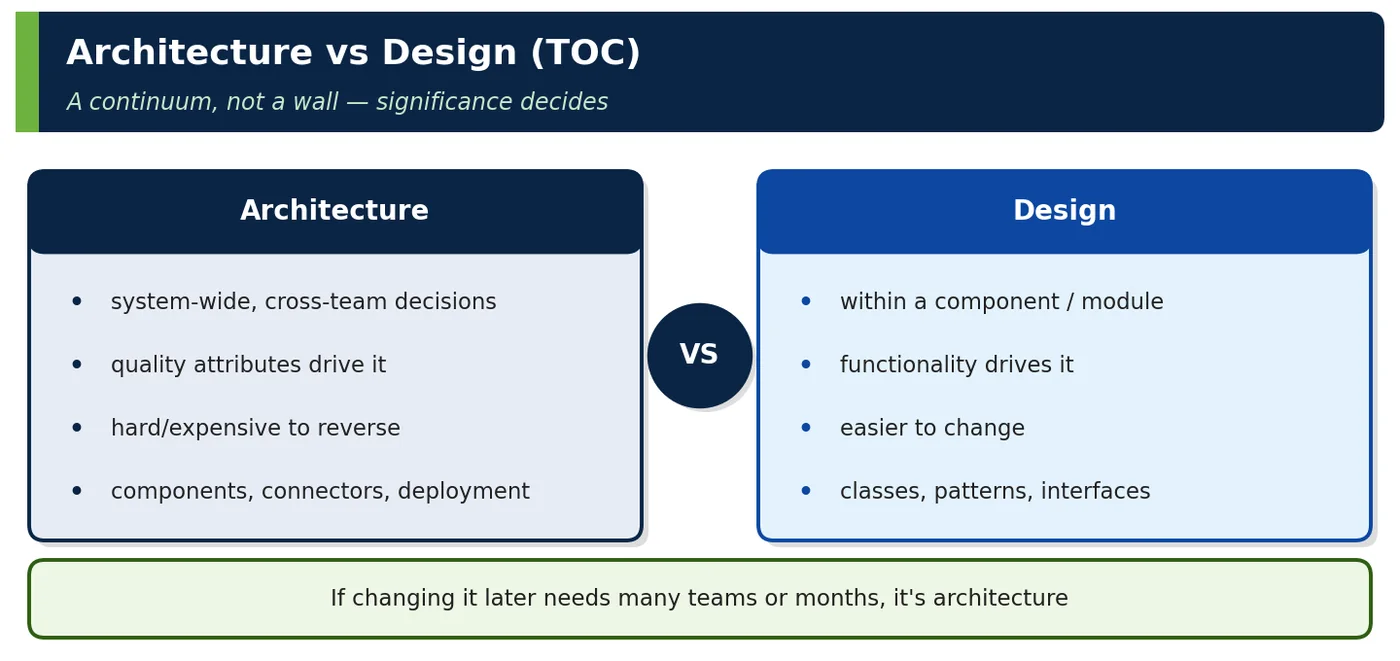
3.2 Architecture vs design
| Decision | Architecture or design? | Why |
|---|---|---|
| Split into Orders and Payments services | Architecture | Boundaries, data ownership, teams |
| Orders ↔ Payments via events | Architecture | Coupling, consistency, availability |
| Strategy pattern for pricing rules | Design | Local to Pricing component |
| DTO naming conventions | Design | Local, cheap to change |
| PostgreSQL vs MongoDB for orders | Architecture | Data model, operations, skills |
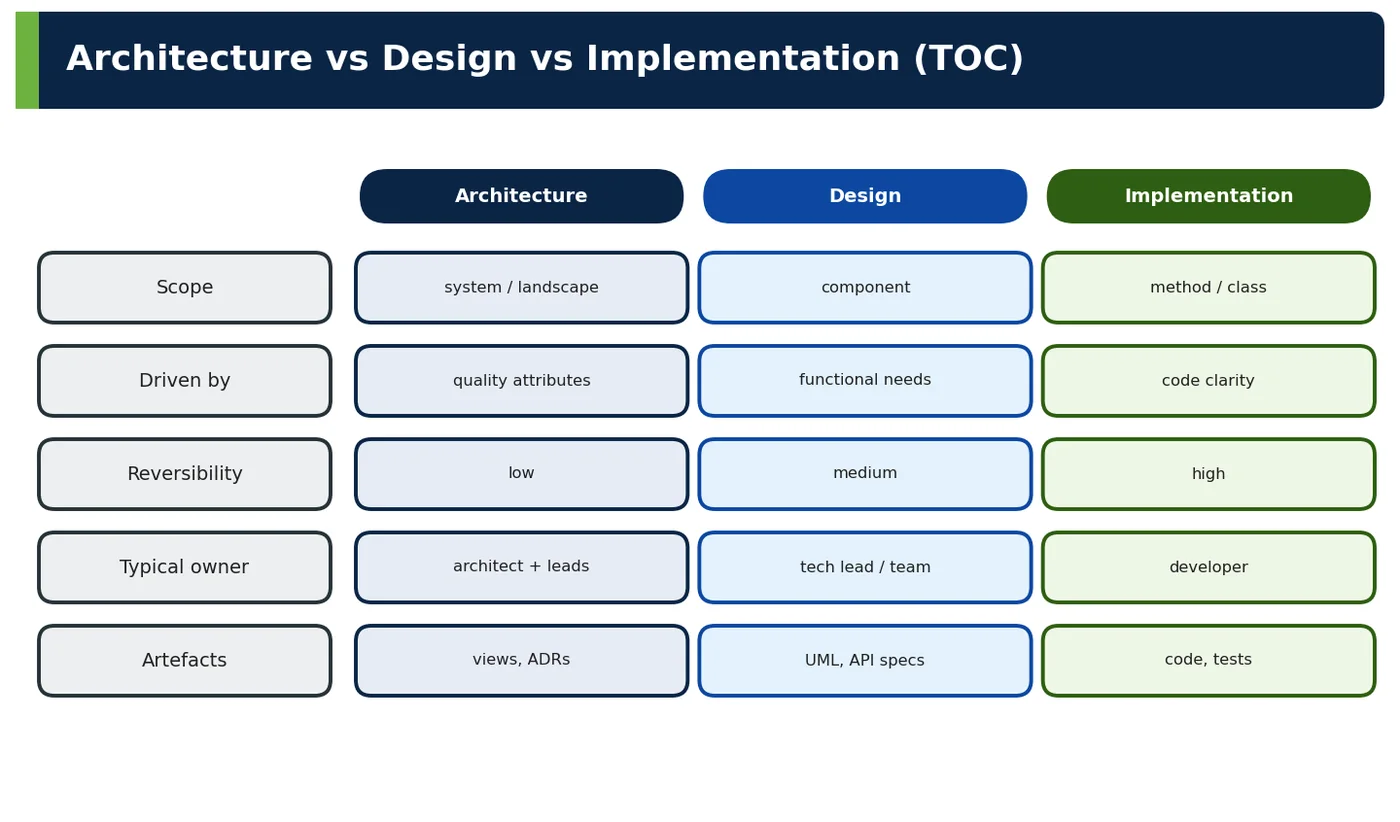
3.3 Architecture vs implementation
// Architecture made visible in implementation: module boundaries in a modular monolith
@ApplicationModule(displayName = "Orders",
                   allowedDependencies = { "catalog::api", "shared" })
package com.shop.orders;

// Verified on every build — architecture, not wishes
@Test
void modulesRespectBoundaries() {
    ApplicationModules.of(ShopApplication.class).verify();
}| Relationship | Description |
|---|---|
| Architecture constrains implementation | Allowed dependencies, technologies, patterns |
| Implementation realises architecture | Code must reflect intended structure |
| Implementation can erode architecture | Shortcuts create drift (architecture erosion) |
| Fitness functions close the loop | Automated checks (ArchUnit, Modulith) |
3.4 Architectural structure

| Structure type | Elements | Answers |
|---|---|---|
| Module | Packages, layers, Maven modules | How is code organised? What depends on what? |
| Component & connector | Services, DBs, queues, APIs | What runs and how does it communicate? |
| Allocation | Nodes, containers, teams, regions | Where does it run, who owns it? |
3.5 Architectural behavior

| Behavioural concern | Architectural question |
|---|---|
| Interaction style | Sync or async between Orders and Payments? |
| Concurrency | Threads/virtual threads, partitions, consumers |
| Failure handling | Timeouts, retries, compensation |
| State & consistency | Where is state, how consistent? |
| Emergent qualities | Latency, throughput, availability under load |
4How It Works Internally — Significance

| Significance signal | Example |
|---|---|
| Affects multiple teams | Shared event contract |
| Drives a quality attribute | Caching strategy for p99 |
| Costly to reverse | Database technology |
| Affects external parties | Public API |
| Introduces new technology | First Kafka use |
4ADeep Dive — Architecture Erosion and Drift
| Phenomenon | Description | Countermeasure |
|---|---|---|
| Drift | Implementation adds decisions not in architecture | Update docs, ADRs |
| Erosion | Implementation violates intended architecture | Fitness functions, reviews |
| Accidental architecture | No intended architecture existed | Recover, then decide explicitly |
// ArchUnit: layered architecture as an executable rule
@ArchTest
static final ArchRule layers = layeredArchitecture().consideringAllDependencies()
        .layer("API").definedBy("..api..")
        .layer("Application").definedBy("..application..")
        .layer("Domain").definedBy("..domain..")
        .layer("Infrastructure").definedBy("..infra..")
        .whereLayer("API").mayNotBeAccessedByAnyLayer()
.whereLayer("Domain").mayOnlyBeAccessedByLayers("Application", "Infrastructure");5APIs / Features / Syntax
| Tool | Architectural purpose |
|---|---|
| Spring Modulith | Module structure, verification, documentation |
| ArchUnit | Executable architecture rules |
| Structurizr / C4 | Model structures as code |
| jQAssistant / Sonargraph | Dependency analysis |
| Maven modules / JPMS | Enforced compile-time boundaries |
6Practical Examples
6.1 The "simple" database choice
A team chose a document database for orders "because JSON is easy". Two years later reporting, transactions across orders and payments, and BI tooling all fought the choice; migration took nine months. The decision was architectural but was treated as a design detail.
6.2 Architecture discovered, not designed
A monolith grew for eight years without explicit structure; every change touched 20 packages. Recovering the implicit architecture with dependency analysis revealed three cyclic clusters, which became the first targets for modularisation.
6.3 Worked example — classify ten decisions
| Decision | Level |
|---|---|
| Event-driven integration | Architecture |
| Kafka as broker | Architecture |
| Topic naming convention | Design |
| Aggregate boundaries | Architecture/design boundary |
| Lombok usage | Implementation |
| Multi-region deployment | Architecture |
| Retry policy defaults | Architecture (platform) |
| Controller method names | Implementation |
| Cache for catalog | Architecture |
| Enum vs string status | Design |
Scenario. At the kick-off of ShopNow's new order platform, the team had a list of ten open decisions and only one architect. They needed to know which decisions deserved architecture review and which teams could make on their own.
Walkthrough. The architect classified each decision by its scope, its effect on quality attributes and its cost of reversal. Event-driven integration, the choice of Kafka and multi-region deployment affect every service and are expensive to undo, so they are architecture. Topic naming conventions are design: they matter, but can be changed with moderate effort. Aggregate boundaries sit on the line between the two, because they shape data ownership. Using Lombok is an implementation detail that any team can decide.
Result. Only four of the ten decisions went to the architecture board; the rest were delegated with guidelines. Review meetings became shorter and teams stopped waiting for approvals they did not need.
Takeaway. Classify decisions explicitly by significance. Spend architecture effort on decisions that are wide in scope, shape quality attributes and are costly to reverse, and delegate everything else with clear guidance.
6.4 Worked example — structures of an order platform
| Structure | Content |
|---|---|
| Module | orders, payments, catalog, shared modules |
| C&C | REST gateway, services, Kafka, PostgreSQL |
| Allocation | EKS in Mumbai, 3 teams |
Scenario. A new engineer asked, "What is the architecture of the order platform?" One senior developer described packages, another described services and Kafka, and a third described AWS regions and teams. All three were right, which confused the new engineer further.
Walkthrough. Each answer described a different structure of the same system. The module structure shows how code is organised: orders, payments, catalog and shared modules. The component-and-connector structure shows runtime elements and how they communicate: a REST gateway, services, Kafka and PostgreSQL. The allocation structure maps software to environments and people: EKS clusters in the Mumbai region and three owning teams. Each structure answers different questions, such as where to change code, how requests flow, or who to call during an incident.
Result. The team documented the platform with one view per structure, linked together. New engineers now read the three views in their first week and understand the system far faster.
Takeaway. No single diagram describes an architecture. Document at least the module, runtime and allocation structures, and say explicitly which one a diagram shows.
6.5 Worked example — behaviour under failure
| Scenario | Designed behaviour |
|---|---|
| Payments slow | Timeout 2 s, order PENDING, retry async |
| Kafka down | Outbox buffers events |
Scenario. ShopNow's checkout called the payment service synchronously and published order events directly to Kafka. Nobody had specified what should happen when either dependency failed, until both failed during a sale.
Walkthrough. The architect wrote down the intended behaviour for each failure before changing any code. If payments respond slowly, checkout waits at most 2 seconds, marks the order PENDING, tells the customer that payment is being confirmed, and retries asynchronously. If Kafka is unavailable, events are written to an outbox table in the same transaction as the order, and a relay publishes them when Kafka recovers.
resilience4j:
  timelimiter:
    instances:
      payments: { timeoutDuration: 2s }
  retry:
    instances:
      payments: { maxAttempts: 3, waitDuration: 500ms }
# Order events: written to the outbox table in the order transaction,
# published to Kafka by a relay (Debezium or a scheduled publisher)
Result. At the next sale, a slow payment provider produced pending orders that completed within minutes instead of failed checkouts, and a short Kafka outage caused no lost events.
Takeaway. Failure behaviour is part of the architecture. Design it explicitly for every important dependency, write it down, and test it, rather than discovering it in production.
6.6 Worked example — cost of change estimate
| Change | Effort |
|---|---|
| Rename class | Minutes |
| Change module boundary | Days–weeks |
| Split database | Months |
Scenario. A product manager asked why the architects spent days debating a database split when renaming a class "takes a minute". He wanted to understand why some changes were treated so differently.
Walkthrough. The architect estimated the cost of three changes of different significance. Renaming a class touches one code base and takes minutes with IDE support. Changing a module boundary means moving code and data, changing interfaces and updating tests, which takes days or weeks. Splitting a shared database requires data migration, new APIs or events, coordination between teams and careful roll-out, which takes months.
Result. The estimate made the reason for careful review obvious: decisions that are cheap to change can be made quickly and fixed later, while decisions that take months to reverse deserve analysis up front.
Takeaway. Use cost of change as the practical test of architectural significance. Make cheap decisions quickly, and invest analysis only where reversal is expensive.
6.7 Worked example — Modulith documentation
@Test
void writeDocumentation() {
    new Documenter(ApplicationModules.of(ShopApplication.class))
            .writeModulesAsPlantUml()
            .writeIndividualModulesAsPlantUml();
}
Scenario. ShopNow's architecture diagrams were drawn by hand and were always out of date. Within months of each redesign, the diagrams no longer matched the modules in the code.
Walkthrough. The team used Spring Modulith, which already knows the application's modules and their dependencies. A test class creates an ApplicationModules model from the main application class and passes it to the Documenter, which writes a PlantUML diagram of all modules plus one diagram per module showing its dependencies and published events. The test runs in every build, and the generated files are published with the project documentation.
Result. Diagrams are regenerated on every build, so they always match the code. When a new dependency appeared between modules, it showed up in the diagram immediately and was discussed in code review.
Takeaway. Generate structural documentation from the code wherever possible. Diagrams that cannot drift are worth more than polished ones that quietly go out of date.
6.8 Worked example — decisions hidden in code
| Code smell | Hidden architectural decision |
|---|---|
@Transactional spanning REST calls | Implicit distributed transaction assumption |
| Direct SQL on another service's schema | Shared-database integration |
| Static singletons for config | Deployment/runtime coupling |
Scenario. During a design review of an older service, the architect found that the documented architecture said "services communicate through events", but the code told a different story.
Walkthrough. Several code patterns revealed architectural decisions nobody had recorded. A @Transactional method that made REST calls to other services implicitly assumed a distributed transaction that did not exist. Direct SQL against another service's schema meant the services were integrated through a shared database. Static singletons holding configuration assumed a single deployment per JVM and made multi-tenant deployment impossible.
// Hidden decision: the payment call is NOT rolled back if the insert fails
@Transactional
public Order place(Cart cart) {
    Order order = orders.save(Order.from(cart));
    paymentClient.charge(order.id(), order.total());   // remote call inside DB tx
    return order;
}
Result. Each smell was recorded as an architectural decision, either accepted with an ADR or scheduled for correction. The REST-in-transaction case was replaced by an outbox and a saga.
Takeaway. Architecture lives in code as much as in documents. Review code for smells that reveal unrecorded decisions, and make each one explicit: accept it with an ADR or fix it.
6.9 Worked example — quality attributes shape structure
| Quality | Structural consequence |
|---|---|
| Scalability of catalog reads | Separate read model + cache |
| Availability of checkout | Async side effects |
| Modifiability of pricing | Isolated pricing module |
Scenario. ShopNow's quality goals said the catalogue must handle ten times today's reads, checkout must stay available during partial outages, and pricing rules must change weekly without risk.
Walkthrough. The architect traced each quality attribute to a structural decision. Scalable catalogue reads led to a separate read model backed by a cache, so reads never touch the transactional database. Available checkout led to asynchronous side effects, so emails, loyalty points and analytics happen through events after the order is saved. Modifiable pricing led to an isolated pricing module with its own tests and deployment, so rule changes cannot break other areas.
Result. Each structure in the architecture could be justified by a named quality goal, and the reviews focused on whether each structure actually achieved its goal.
Takeaway. Derive structure from quality attributes, not from fashion. For every major structural element, you should be able to name the quality goal it serves.
6.10 Worked example — architecture in a small system
| System | Architecture still exists? |
|---|---|
| 3-developer internal tool | Yes: framework, DB, deployment, auth — few but significant decisions |
Scenario. A team of three developers building an internal expense tool said their system was "too small to have an architecture" and skipped any design discussion.
Walkthrough. Even this small tool had a handful of significant decisions: the web framework, the database, how it is deployed and how users authenticate. Within six months, the choice of a shared database with the HR system, made casually, meant every HR schema change broke the expense tool, and the custom login had to be replaced by company single sign-on under audit pressure.
Result. A one-hour discussion at the start, recorded in two short ADRs, would have avoided both problems. The team now records the few significant decisions in every new project, however small.
Takeaway. Every system has an architecture, either intended or accidental. Small systems need few architectural decisions, but those few still deserve to be made deliberately and written down.
6.11 Worked example — enforcing no cycles
@ArchTest
static final ArchRule noCycles = slices().matching("com.shop.(*)..")
        .should().beFreeOfCycles();
Scenario. ShopNow's monolith had developed dependency cycles between packages: orders depended on payments, which depended on customers, which depended on orders. Every change rippled unpredictably.
Walkthrough. The team added an ArchUnit rule that treats each top-level package under com.shop as a slice and requires the slices to be free of cycles. Existing violations were recorded in a freeze file, so the build passes for known cycles but fails for any new one.
@AnalyzeClasses(packages = "com.shop")
class ArchitectureTest {
    @ArchTest
    static final ArchRule noCycles = freeze(
        slices().matching("com.shop.(*)..").should().beFreeOfCycles());
}
Result. No new cycles were introduced after the rule was added, and the frozen violations shrank from 14 to 2 over two quarters as teams fixed them during normal work.
Takeaway. Turn architectural rules into executable tests. Freezing existing violations lets you introduce rules into legacy code without stopping delivery, while still preventing things from getting worse.
6.12 Worked example — architecture vs framework
| Statement | Correct? |
|---|---|
| "Our architecture is Spring Boot" | ✘ — technology choice, not architecture |
| "Modular monolith with event-based module integration on Spring Boot" | ✔ |
Scenario. In a client presentation, a team described their solution's architecture as "Spring Boot on Kubernetes". The client's architect asked how the system was structured, and the team had no clear answer.
Walkthrough. Naming frameworks and platforms describes technology choices, not architecture. A useful description states structure and behaviour: for example, a modular monolith with modules for orders, payments and catalogue, integrated through in-process events, deployed as one Spring Boot application on Kubernetes. That sentence tells the listener how the system is divided, how parts communicate and how it is deployed.
Result. The team rewrote their architecture summary around structure, communication and deployment, and moved the technology list to a separate section. The client's follow-up questions became about trade-offs rather than buzzwords.
Takeaway. Describe architecture by its structures, interactions and key decisions; mention technologies as supporting choices. Tools change far more often than structure.
6.13 Worked example — runtime behaviour metrics
| Behaviour | Metric |
|---|---|
| Interaction latency | p99 per call |
| Throughput | orders/s |
| Failure handling | error & retry rates |
Scenario. An architecture review claimed that ShopNow's checkout was "fast and resilient". The review board asked how anyone would know if that stopped being true.
Walkthrough. The team defined metrics for each aspect of runtime behaviour. Interaction latency is measured as p99 per call between services. Throughput is measured in orders per second at peak. Failure handling is measured through error rates and retry rates per dependency. Each metric has a target, a dashboard and an alert.
# Example SLOs for checkout behaviour
checkout-latency:   { metric: http.server.requests, uri: /api/checkout, p99: 800ms }
checkout-throughput: { metric: orders.placed, target: 120/s at peak }
payment-retries:    { metric: resilience4j.retry.calls, kind: failed_with_retry, max: 1% }
Result. When a dependency upgrade doubled payment retries a month later, the alert fired before customers noticed, and the team rolled back the change.
Takeaway. Architectural behaviour is measurable. Turn claims such as "fast" and "resilient" into metrics with targets, so the architecture can be verified continuously.
6.14 Worked example — who decides
| Decision | Decider |
|---|---|
| Service boundaries | Architect with tech leads |
| Internal class design | Team |
Scenario. Teams at ShopNow complained that architects slowed them down by reviewing everything, while architects complained that teams made boundary-changing decisions without telling anyone.
Walkthrough. The architecture group published decision rights based on significance. Service and module boundaries, integration styles and data ownership are decided by architects together with tech leads, because they affect many teams. Internal class design, libraries within approved lists and code structure inside a module are decided by the team alone.
Result. Review requests fell by more than half, and the decisions that still reached the architects were the ones that mattered. Teams also knew exactly when to involve an architect.
Takeaway. Make decision rights explicit and tie them to significance. Clear rights speed teams up and protect the decisions that really need wider input.
6.15 Worked example — ISO 42010 terms applied
| Term | Example |
|---|---|
| System | Order platform |
| Stakeholder | Operations |
| Concern | Recoverability |
| View | Deployment view |
Scenario. ShopNow's architecture documents used words like "view", "perspective" and "concern" inconsistently, so readers often misunderstood what a section was meant to cover.
Walkthrough. The team adopted ISO/IEC/IEEE 42010 vocabulary. The system is the order platform. Stakeholders are people with interests in it, such as operations. A concern is something a stakeholder cares about, such as recoverability. A view is a representation addressing specific concerns, such as the deployment view showing how the system recovers from a zone failure. Each document section now states which stakeholders and concerns it addresses.
Result. Reviews became more focused: stakeholders could find the views relevant to them, and missing concerns, such as security for the compliance team, were easy to spot.
Takeaway. Use a standard vocabulary for architecture descriptions. Naming stakeholders and concerns explicitly shows which views are needed and which are missing.
6.16 Worked example — architecture description outline
| Section | Content |
|---|---|
| Drivers | Goals, NFRs, constraints |
| Structures | C4 views |
| Behaviour | Key sequences |
| Decisions | ADRs |
Scenario. A new project's architecture document had reached 80 pages and nobody read it. The team asked what the minimum useful description would be.
Walkthrough. The architect proposed four sections. Drivers capture business goals, quality requirements and constraints. Structures show C4 context, container and component views. Behaviour shows a few key runtime sequences, such as checkout and refund. Decisions are recorded as short ADRs linked from the relevant views. Everything else, such as detailed API specifications, lives in the code repositories.
docs/architecture/
  01-drivers.md        goals, quality attributes, constraints
  02-structures.md     C4 context + container + key components
  03-behaviour.md      checkout and refund sequences
  adr/                 ADR-001 ... ADR-023
Result. The new description fits in about 15 pages plus ADRs, is updated in the same pull requests as code changes, and is actually read by new engineers.
Takeaway. A short, current architecture description is far more valuable than a long, stale one. Cover drivers, structures, behaviour and decisions, and keep it next to the code.
6.17 Worked example — erosion metric
| Metric | Trend |
|---|---|
| ArchUnit violations frozen | ↓ over time |
| Cross-module dependencies | stable |
Scenario. ShopNow's leadership asked whether two years of architecture work had actually improved the code base, or just produced documents.
Walkthrough. The architecture group tracked two simple health metrics over time. The number of frozen ArchUnit violations shows legacy rule-breaking being paid down. The number of dependencies between modules shows whether coupling is stable or growing.
Result. Frozen violations fell steadily over six quarters, while cross-module dependencies stayed flat even as features were added. Leadership could see the architecture improving in data rather than opinion.
Takeaway. Track a few architecture health metrics and review them regularly. Trends are more useful than absolute numbers, and they show whether architecture is enforced in practice.
6.18 Worked example — interview answer
| Part | Content |
|---|---|
| Definition | Significant structures + decisions |
| Distinction | Cost of change, scope, QAs |
| Evidence | Views, ADRs, fitness functions |
Scenario. In interviews for architect roles, ShopNow found that many candidates could define architecture in one sentence but could not explain why the definition mattered.
How to answer. A strong answer has three parts. The definition: architecture is the set of significant structures and decisions of a system. The distinction: it differs from design by its system-wide scope, its link to quality attributes and its high cost of change. The evidence: architecture is made visible through views, recorded in ADRs and protected by fitness functions such as ArchUnit rules.
Why it works. Candidates who answered in this structure, with a short example from their own work, consistently performed better in the deeper design discussion that followed.
Takeaway. In interviews, follow a definition with a distinction and evidence from practice. That shows you understand architecture as a working discipline, not just a term.
7Common Problems & Mistakes
- Equating architecture with technology stack.
- Treating significant decisions as design details.
- Ignoring runtime behaviour in architecture.
- Architecture only in slides, not enforced in code.
- Over-architecting trivial decisions.
- No distinction between intended and implemented architecture.
8Performance & Production Considerations
| Aspect | Guideline |
|---|---|
| Significance | Focus effort on costly-to-change decisions |
| Structure | Module, C&C and allocation views |
| Behaviour | Designed interactions and failure handling |
| Enforcement | ArchUnit, Modulith, dependency checks |
| Drift | Regular recovery and updates |
9Architecture & Design Considerations
- Define architecture by significance and reversibility.
- Describe structure and behaviour together.
- Make architecture executable through fitness functions.
- Let quality attributes drive structure.
10Interview Questions & Answers
What is software architecture?
Software architecture is the set of significant structures of a system, their elements and relationships, together with the decisions and principles that shape them. "Significant" is the key word: architecture covers the decisions that affect the whole system, determine its quality attributes such as scalability or security, and are expensive to change later. Examples include how the system is divided into modules or services, how they communicate, who owns which data and how it is deployed. Every system has an architecture, whether it was designed deliberately or emerged by accident; the architect's job is to make it intentional.
How does architecture differ from design?
Architecture and design form a continuum, separated by significance. Architecture covers decisions with system-wide scope that shape quality attributes and are hard to reverse, such as service boundaries, integration style, data ownership or the deployment model. Design covers decisions inside a component, such as class structure, patterns and algorithms, which affect fewer people and can be changed with moderate effort. For example, choosing event-driven integration between services is architecture, while choosing a Strategy pattern for discount rules inside the pricing module is design. The distinction tells you where to invest review effort and who should decide.
What are the three families of architectural structures?
Architectural structures fall into three families. Module structures show how the code is organised into units of implementation, such as packages, modules and layers, and their dependencies; they answer questions about where to change code. Component-and-connector structures show runtime elements, such as services, databases and brokers, and how they interact, for example over REST or Kafka; they answer questions about behaviour, performance and availability. Allocation structures map software to its environment, such as servers, clusters, regions and teams; they answer questions about deployment and ownership. A complete description needs all three.
What is architectural behaviour?
Architectural behaviour is how a system's elements interact while it runs: the order of calls in a process, which interactions are synchronous or asynchronous, how concurrency and load are handled, and what happens when something fails. Two systems with identical structures can behave very differently, for example if one retries failed calls with back-off and the other fails immediately. Behaviour is documented with sequence diagrams and runtime views for key flows, and verified with metrics such as latency, throughput and error rates. Failure behaviour in particular must be designed deliberately, not discovered in production.
How do you keep implementation aligned with architecture?
Make the architecture executable and visible. Encode rules, such as allowed dependencies between layers and modules or the absence of cycles, as ArchUnit tests or Spring Modulith verification that run in every build, so violations fail fast. Generate diagrams from the code so documentation cannot drift. Review architecturally significant changes, such as new dependencies between modules or new integrations, in code review with clear guidelines. Periodically recover the actual architecture from the code and runtime traces, compare it with the intended one, and either fix deviations or update the intended architecture deliberately.
What is architecture erosion?
Architecture erosion is the gradual divergence of the implemented system from its intended architecture. It happens through many small, individually reasonable shortcuts: a direct call that bypasses an interface, a query against another module's tables, a shared class that couples two services. No single change looks harmful, but over time the boundaries that made the system maintainable disappear, changes ripple unpredictably and teams lose independence. Erosion is countered by executable architecture rules, regular measurement of dependencies, visible technical debt, and making the intended architecture easy to follow.
How do you decide whether a decision is architectural?
Ask four questions. What is the scope: does the decision affect one component or many? Does it influence important quality attributes, such as performance, availability or security? How many teams does it affect? And how expensive would it be to reverse, in time, money and risk? A decision with wide scope, quality-attribute impact, several affected teams or high reversal cost is architectural and deserves analysis, review and an ADR. For example, choosing a message broker is architectural, while choosing a JSON library inside one service usually is not.
How would you explain your system's architecture to a new stakeholder?
Start from why the system exists: its business goals, key quality requirements and constraints, in the stakeholder's language. Then show a context view, the system and the people and systems around it, followed by a container view of the main deployable parts and data stores. Walk through one or two key runtime flows, such as placing an order, to show how the parts work together. Finally, highlight the few major decisions and their rationale, such as why events were chosen over synchronous calls. Tailor the depth to the stakeholder's concerns and avoid jumping straight into technology lists.