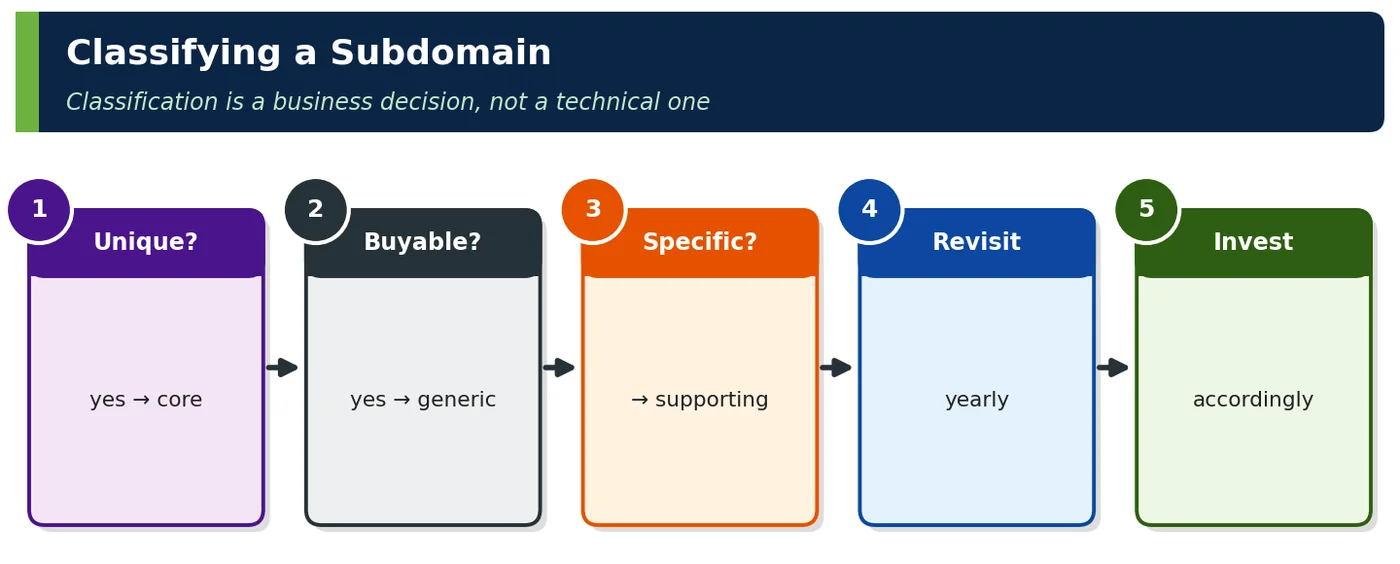
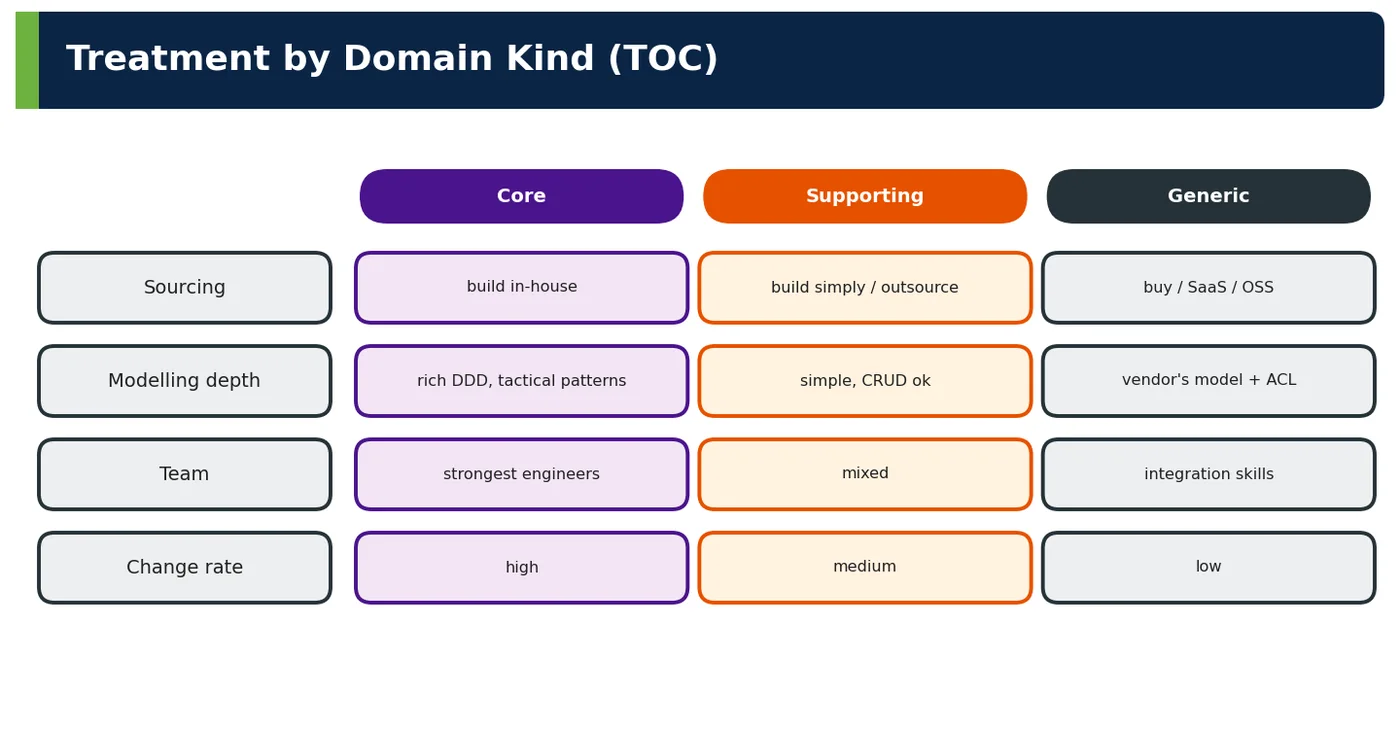
Classify parts of a domain as core, supporting or generic using differentiation and complexity, choose sourcing, modelling depth and team allocation per type, visualise classification on a core domain chart, protect the core from generic concerns, and revisit classification as markets evolve
Not all parts of a business are equally important or complex. DDD distinguishes the core domain — where the business differentiates — from supporting and generic domains, so effort and talent go where they create the most value.
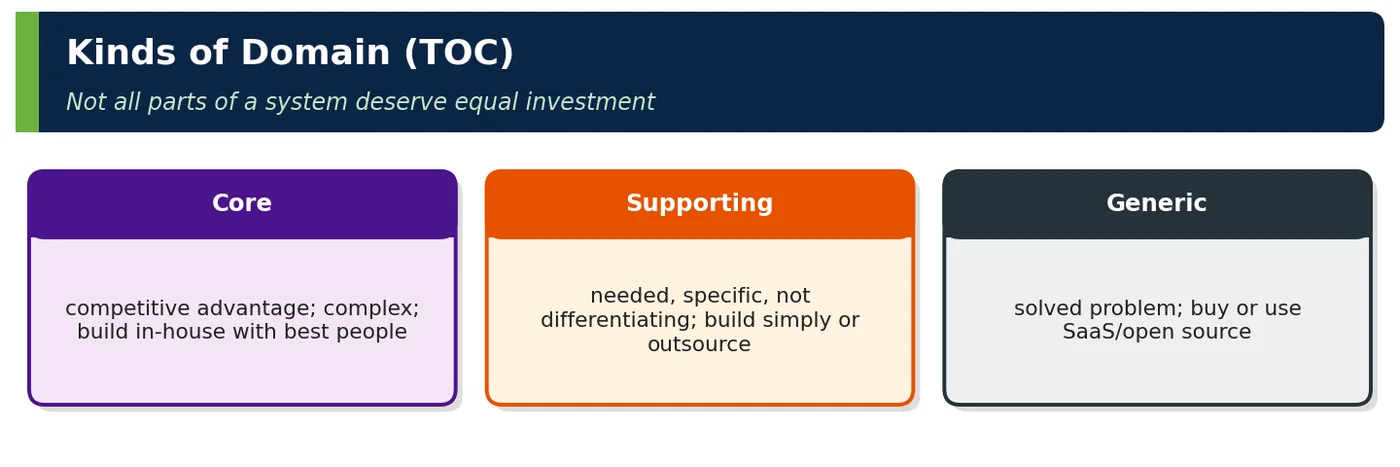
Figure 1 — Kinds of domain (TOC)
TOC type
Definition
Core
The part of the domain that provides competitive advantage — complex, differentiating, frequently changing; built in-house with the best people and richest modelling
Supporting
Specific to the business and necessary, but not differentiating; moderate complexity; built simply or outsourced with less rigour
Generic domain
Common problems solved the same way by everyone (identity, payments processing, email, accounting); bought, subscribed to or taken from open source
Table 1 — The three TOC types
2Why It Exists
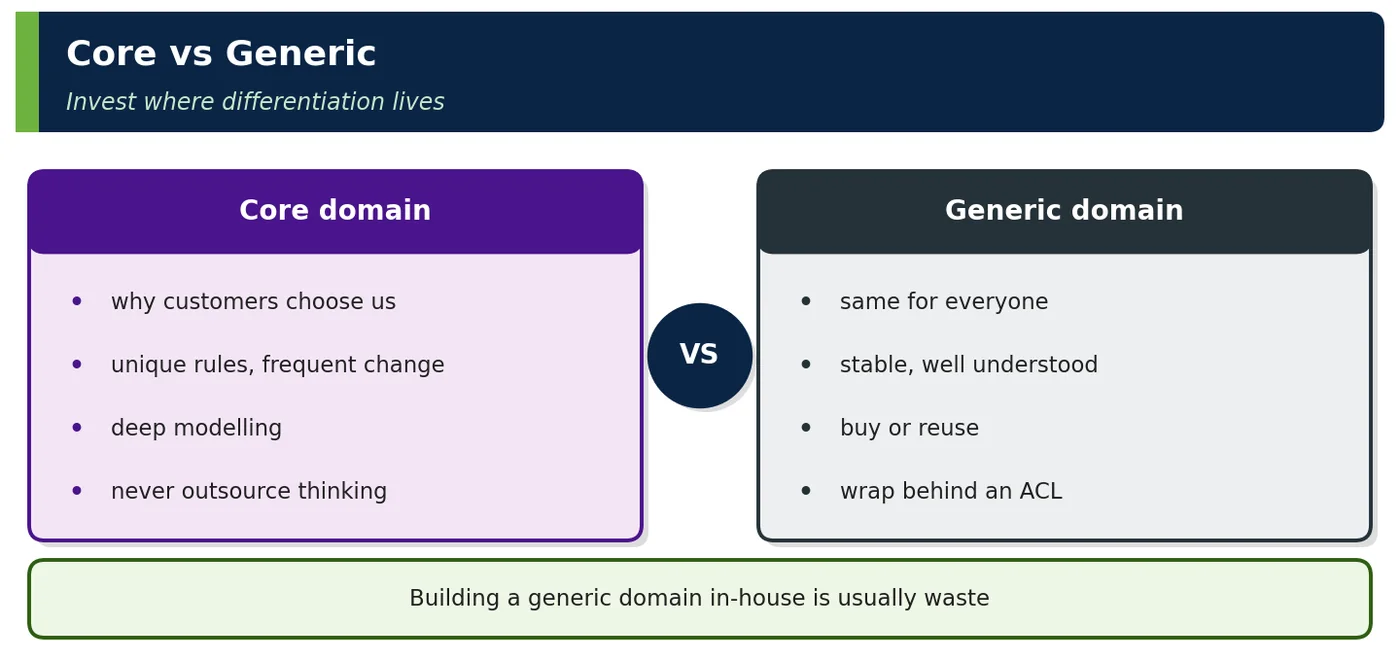
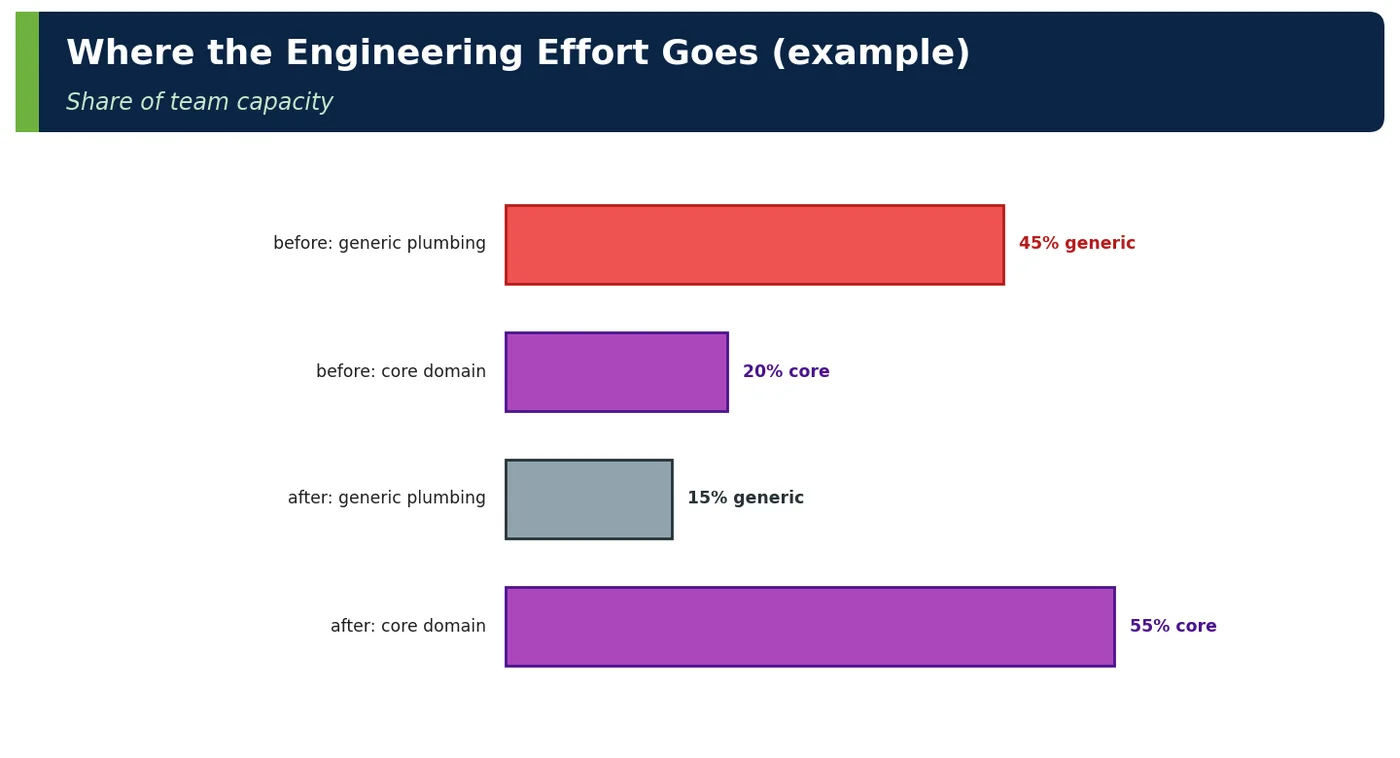
Teams naturally gravitate to technically interesting problems — building their own auth server, workflow engine or reporting framework — while the differentiating business logic gets less attention. Classifying domains realigns investment with strategy.
Investment usually follows interest or habit rather than value. Engineers enjoy hard technical problems, so they build identity servers and workflow engines; budgets are often spread evenly across systems; and vendors offer packages for almost anything, including the parts that make the company different. Without a classification, nobody can say which of these choices is a mistake. Distinguishing core, supporting and generic domains gives a shared language for those decisions. It tells leaders where the best engineers and domain experts should sit, which areas deserve rich modelling and deep testing, and which should be bought, configured and wrapped. It also exposes risk: a core domain run by a vendor or by an understaffed team is a strategic weakness, even when the code works.
A mid-size retailer spent 18 months building its own identity server. After classifying identity as generic, they migrated to a managed IdP and moved four engineers to pricing, which shipped personalised promotions in a quarter.
6.2 Outsourced core
An insurer outsourced its rating engine to a vendor package; competitors launched usage-based products faster. Rating was reclassified as core and rebuilt in-house around the vendor's data feeds.
6.3 Worked example — classification table
Subdomain
Type
Rationale
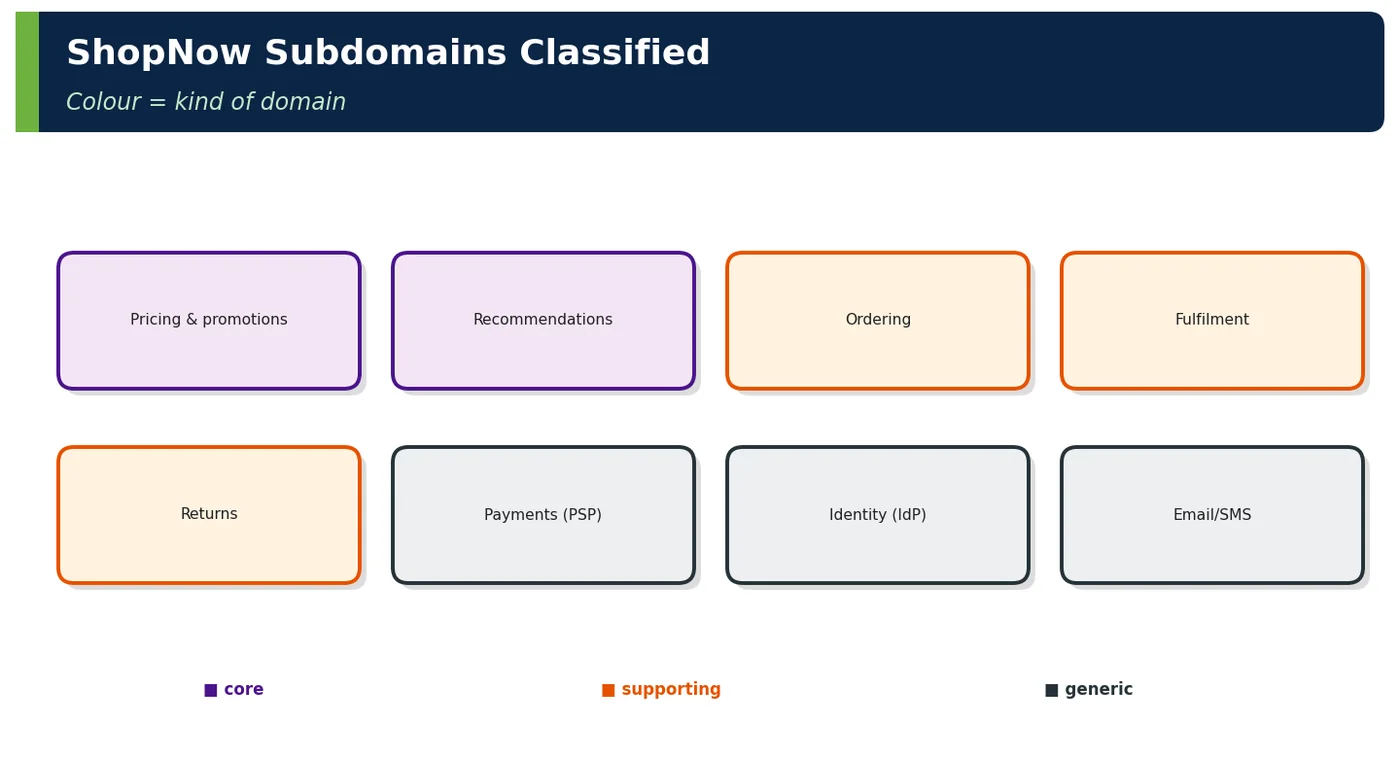
Pricing & promotions
Core
Margin & conversion edge
Recommendations
Core
Personalisation edge
Ordering
Supporting
Necessary, standard-ish
Fulfilment
Supporting
Specific warehouse rules
Payments
Generic
PSP does it
Identity
Generic
IdP
Table 8 — ShopNow
6.4 Worked example — team allocation
Type
Team
Core
Senior, stable, co-located with experts
Supporting
Mixed seniority
Generic
Integration specialists
Table 9 — People follow value
6.5 Worked example — build/buy decision
Criterion
Payments
Differentiation
None
Vendor maturity
High
Decision
Buy (PSP) + ACL
Table 10 — Generic → buy
6.6 Worked example — core domain chart reading
Quadrant
Meaning
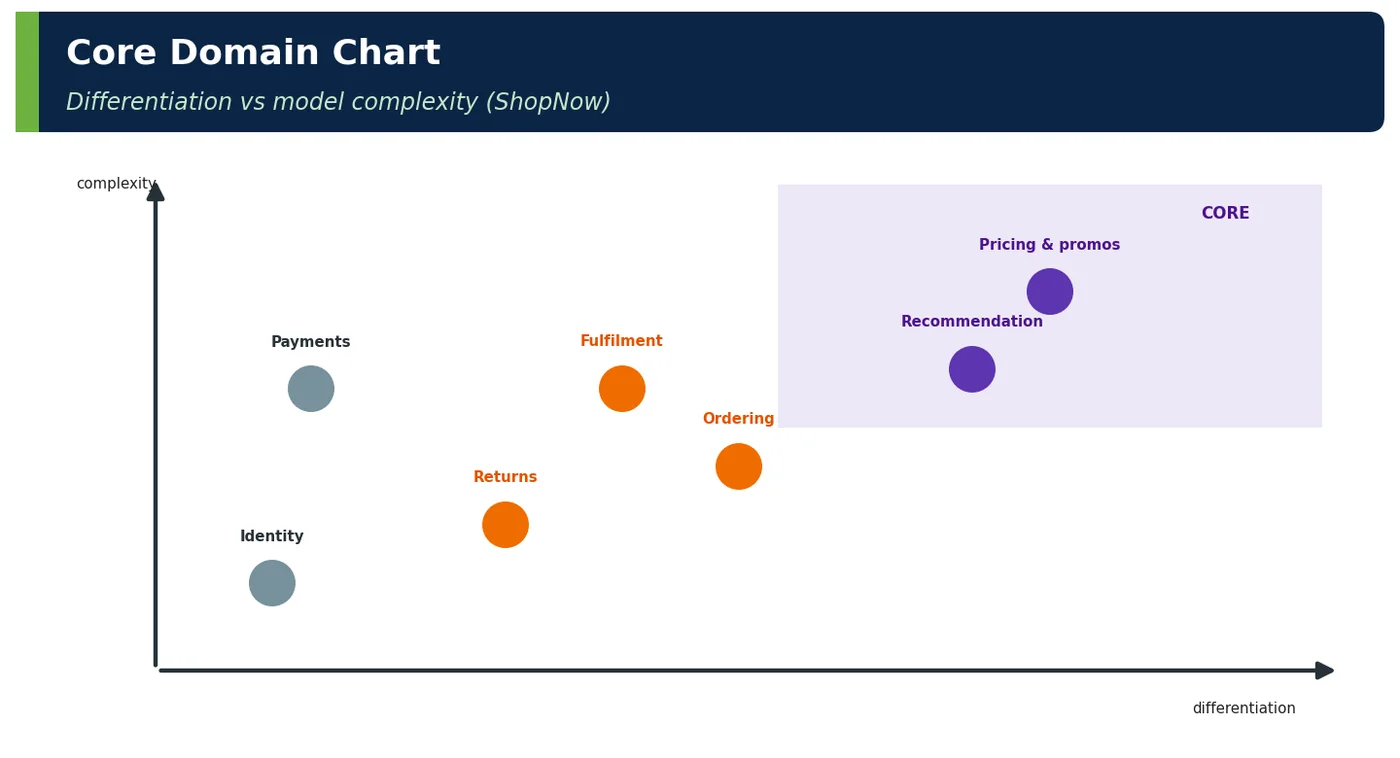
High differentiation, high complexity
Core — invest
Low differentiation, high complexity
Generic — buy
Low, low
Supporting — keep simple
Table 11 — Using the chart
6.7 Worked example — domain vision statement
Core
Statement
Pricing
"Launch any promotion in hours, never below margin floor"
Table 12 — Focus statement
6.8 Worked example — segregated core
Step
Action
Extract promotion rules from monolith
Own module, rich model
Table 13 — Distil the core
6.9 Worked example — measuring investment
Metric
Target
% capacity on core
> 50%
Table 14 — Track alignment
6.10 Worked example — generic via ACL
Vendor term
Our term
payment_intent
PaymentAuthorisation
Table 15 — Protect language
6.11 Worked example — supporting done simply
Choice
Effect
Spring Data REST for store locations
Days not weeks
Table 16 — Right-sized effort
6.12 Worked example — reclassification
Year
Recommendations
2022
Core
2026
Supporting (commodity ML services)
Table 17 — Classification evolves
6.13 Worked example — complexity ≠ core
Area
Complexity
Type
Tax calculation
High
Generic (buy tax engine)
Table 18 — Complex but not differentiating
6.14 Worked example — quality bars
Type
Test depth
Core
Unit + property + scenario
Supporting
Integration tests
Table 19 — Different rigour
6.15 Worked example — stakeholder conversation
Question to business
Purpose
"Why do customers pick us?"
Find the core
Table 20 — Business-led classification
6.16 Worked example — portfolio view
Domain type
Count of services
Core
3
Supporting
7
Generic (integrations)
5
Table 21 — Landscape view
6.17 Worked example — risk of generic customisation
Risk
Mitigation
Heavy ERP customisation
Keep ERP vanilla; custom rules in own context
Table 22 — Don't make generic special
6.18 Worked example — outsourcing supporting
Domain
Outsourced?
Store locator app
✔ to partner
Table 23 — Acceptable outsourcing
6.19 Worked example — ADR
Field
Content
Decision
Buy IdP; build pricing
Rationale
Classification & chart
Table 24 — Documented
6.20 Worked example — core protection
Rule
Effect
No vendor SDK imports in pricing domain
Clean core
Table 25 — ArchUnit rule
6.21 Worked example — interview answer
Type
Treatment
Core
Build, best people, rich model
Supporting
Simple build/outsource
Generic
Buy + ACL
Table 26 — Structured answer
7Common Problems & Mistakes
Building generic domains in-house.
Outsourcing the core.
Equating complexity with core.
Uniform investment across domains.
Technical teams classifying alone.
Never revisiting classification.
Most of these mistakes come from classifying by technical interest or complexity instead of by competitive advantage. Building a generic domain in-house, such as an identity server, consumes senior engineers who should be working on pricing or recommendations. Outsourcing the core does the reverse: the company loses the knowledge and speed that make it different, as the insurer in Example 6.2 discovered. Equating complexity with core leads teams to build tax engines that could be bought. Uniform investment gives supporting domains the same rigour as the core, raising cost without benefit. When technical teams classify alone, they miss what customers actually value, and when nobody revisits the classification, yesterday's differentiator keeps absorbing investment after it has become a commodity.
8Performance & Production Considerations
Aspect
Guideline
Classification
Business-led, documented
Investment
Majority to core
Generic
Buy, wrap with ACL
Supporting
Simple, cost-efficient
Review
Annually or on strategy change
Table 27 — Operational guidelines
9Architecture & Design Considerations
Let differentiation drive classification.
Match sourcing, modelling depth and teams to type.
Protect the core from generic models.
Revisit as markets evolve.
10Interview Questions & Answers
Q1BasicConcept
What is the core domain?
The core domain is the part of the business that gives it competitive advantage, the reason customers choose it over competitors. It is usually complex, changes frequently and depends on deep expertise, and it cannot simply be bought, because a vendor would sell the same capability to everyone. For ShopNow it is dynamic pricing and promotions: stacking rules, margin guards and weekly campaign mechanics. The core deserves the best people, close collaboration with domain experts, rich modelling such as aggregates in a hexagonal structure, and thorough testing. The useful test is not whether it is complex, but whether doing it better than competitors makes the business win; if not, it is not core.
Q2BasicConcept
Give examples of generic domains.
Generic domains are problems every business has and solves in much the same way. Typical examples are identity and access management, payments processing, notifications by email or SMS, accounting, document storage and tax calculation. They are often complex, but they are not differentiating, so mature products exist: Keycloak, Okta or Cognito for identity, Stripe, Razorpay or Adyen for payments, SES or Twilio for messaging, and ERP SaaS for accounting. The right approach is to buy, subscribe or adopt open source, configure the product rather than customise it heavily, and wrap it behind an anti-corruption layer so the vendor's model and terminology do not leak into your core domain.
Q3IntermediateConcept
What distinguishes supporting from generic?
The difference is whether the problem is specific to your business. A supporting domain is necessary and particular to how you operate, but customers do not choose you because of it. ShopNow's returns authorisation workflow and warehouse fulfilment rules are examples: nobody sells them off the shelf exactly as needed, yet they are not a competitive edge. A generic domain is a problem every business shares, such as identity or payments, so products already solve it well. The consequence is sourcing: supporting domains are built simply, using layered Spring Boot, low-code or an outsourcing partner, while generic domains are bought or reused. Neither deserves the investment the core receives.
Q4IntermediateDesign
How should generic domains be integrated?
Buy or reuse a mature product, and integrate it through an anti-corruption layer that keeps its model outside your domain. In practice you define a port in your own language, for example a PaymentGateway interface whose authorise method takes your OrderId and Money, and implement it with an adapter such as RazorpayPaymentGateway that translates to the vendor's API and terms like payment_intent. Domain code depends only on the port, so the vendor can be upgraded or replaced with limited change. Keep the product as close to vanilla as possible, because heavy customisation turns a generic tool into a costly special case. An ArchUnit rule can forbid vendor SDK imports in the core.
Q5Senior EngineerTricky
Is a complex area always core?
No. Complexity and differentiation are separate dimensions, and confusing them is a common and expensive mistake. Tax calculation is a good example: GST or VAT rules are intricate and change regularly, but every retailer must apply them in the same way, and customers never choose a shop because its tax engine is clever. That makes it a generic domain, best handled by a specialist tax engine. On a core domain chart, high complexity with low differentiation falls in the buy quadrant. The opposite also happens: a fairly simple pricing rule can be core if it gives a real market edge. Always ask what makes the business win, not what is hard.
Q6Senior EngineerDesign
How does classification affect design?
Classification decides how much modelling and engineering rigour each part receives. Core domains get rich domain models with aggregates and value objects, a hexagonal or onion structure that keeps business logic free of frameworks, and deep testing including property-based and scenario tests; ShopNow's PromotionStack is an example. Supporting domains can use straightforward layered Spring Boot services, Spring Data REST or even low-code, with integration tests being enough. Generic domains get almost no custom design beyond the adapter and anti-corruption layer around a bought product. Classification also shapes team allocation and boundaries: core teams are senior and stable, and the core is often segregated into its own module or service.
Q7Technical ArchitectConcept
Why reclassify periodically?
Because markets change, and today's differentiator becomes tomorrow's commodity. Product recommendations were core for ShopNow in 2022, but by 2026 managed ML services made good recommendations available to every competitor, so the area became supporting and investment moved elsewhere. New differentiators also appear, as with the insurer whose rating engine became core once usage-based products mattered. If classification is never revisited, the company keeps investing senior talent in areas that no longer win customers and under-invests in emerging ones. A practical rhythm is an annual review with business leaders, plus a review whenever strategy changes, using a core domain chart or Wardley map to show movement.
Q8Solution ArchitectScenario
How would you use classification in a portfolio decision?
I would run a workshop with business leaders and domain experts to list the subdomains and place each on a core domain chart by differentiation and complexity. Then I decide sourcing per type: build the core in-house with the best people, build supporting domains simply or outsource them, and buy generic ones behind anti-corruption layers. Next I compare that with current reality, for example a team maintaining a home-grown identity server, and rebalance capacity towards the core, aiming for more than half of engineering effort there. Each build, buy or outsource decision goes into an ADR with its rationale, and the classification is reviewed annually or whenever strategy changes.
Newsletter
Get new tutorials every week
New ArchitectMind tutorials and interview questions, once a week. No spam, unsubscribe anytime.
Your subscription could not be saved. Please try again.
Almost done! Check your inbox and click the confirmation link to complete your subscription.
 Architect