 Architect

- Chapter
- Chapter 1 — Architecture Interview Framework
- Prerequisites
- Volume III (requirements and quality attributes); Volume VII Chapter 2
- You will be able to
- Run a structured clarification phase for any design prompt, identify actors, core use cases and the hard part, negotiate scope explicitly, define success measures, restate the problem for agreement, and manage time so that clarification strengthens rather than delays the design
- Covers
- Clarifying requirements
On this page
- 1. Concept / Definition
- 2. Why It Exists
- 3. Core Concepts — The Clarification Funnel
- 4. How It Works Internally — A Clarification Script
- 4A. Deep Dive — Finding the Hard Part
- 4B. Deep Dive — Negotiating Scope
- 4C. Deep Dive — Functional vs Non-Functional Clarification
- 4D. Deep Dive — System Design vs Solution Architect Interviews
- 4E. Deep Dive — Recovering From a Misunderstanding
- 4F. Deep Dive — Time-Boxing
- 5. APIs / Features / Syntax
- 6. Practical Examples
- 7. Common Problems & Mistakes
- 8. Performance & Production Considerations
- 9. Architecture & Design Considerations
- 10. Interview Questions & Answers
1Concept / Definition
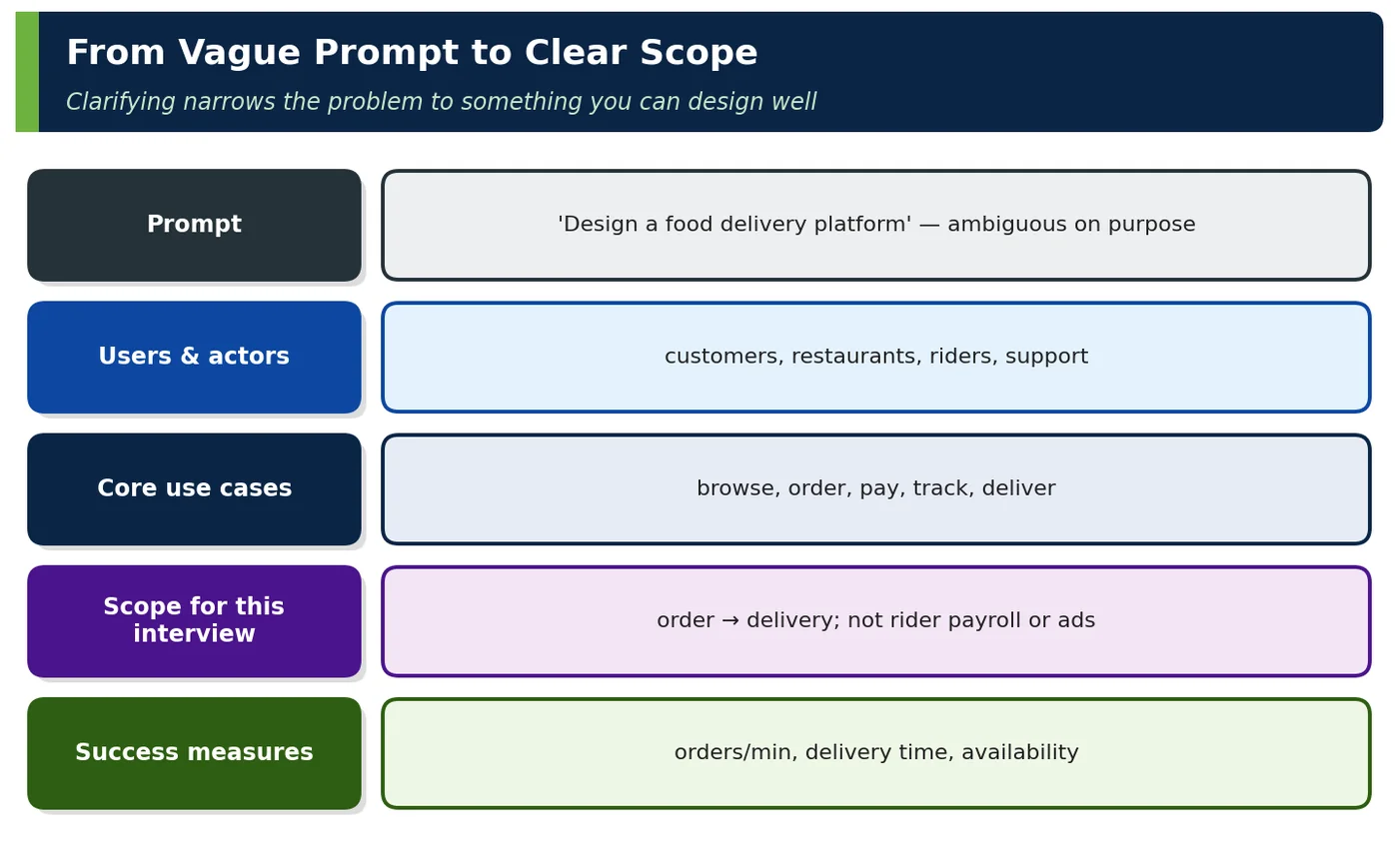
Clarifying requirements in an architecture interview is the short, structured conversation at the start where you turn an ambiguous prompt into an agreed problem statement: who the users are, what they must be able to do, what is in and out of scope, and how success will be measured. Interview prompts are vague on purpose — the interviewer wants to see whether you can find the real problem before solving it, which is exactly what solution architects do with stakeholders.
| Vocabulary | Meaning |
|---|---|
| Actor | A person or system that interacts with the solution |
| Core use case | A goal an actor must achieve; defines the critical path |
| Scope box | Written list of what is in and out of scope, kept on the board |
| Hard part | The aspect that makes the problem genuinely difficult (e.g., seat contention) |
| Restatement | Summary of your understanding for the interviewer to confirm |
2Why It Exists
| Without clarification | Consequence in the interview |
|---|---|
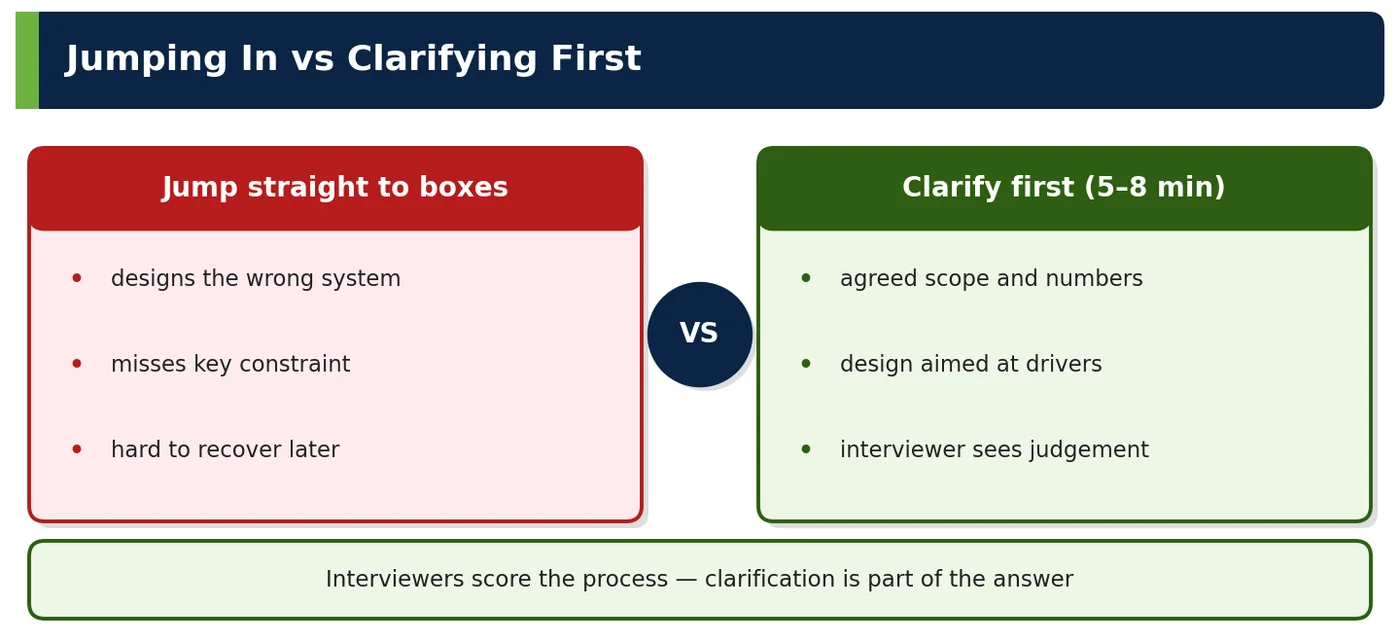
| Design the wrong system | Interviewer redirects at minute 25; time lost |
| Miss the hard part | Design is generic; no depth where it matters |
| Scope explodes | You try to design ads, loyalty and payroll too |
| No numbers | Scaling discussion becomes hand-waving |
| No shared understanding | Later challenges feel like moving goalposts |
The same is true in real engagements: most failed architectures solved a problem nobody had, or ignored the one constraint that mattered. Interviewers use the clarification phase as a proxy for how you will behave in a discovery workshop.
3Core Concepts — The Clarification Funnel
| Level | Question to answer | QuickBite example |
|---|---|---|
| Actors | Who interacts with the system? | Customers, restaurants, riders, support agents |
| Use cases | What must each actor accomplish? | Browse, order, pay, track; accept order; pick up and deliver |
| Critical path | Which use case must never fail? | Place order → restaurant accepts → rider assigned → delivered |
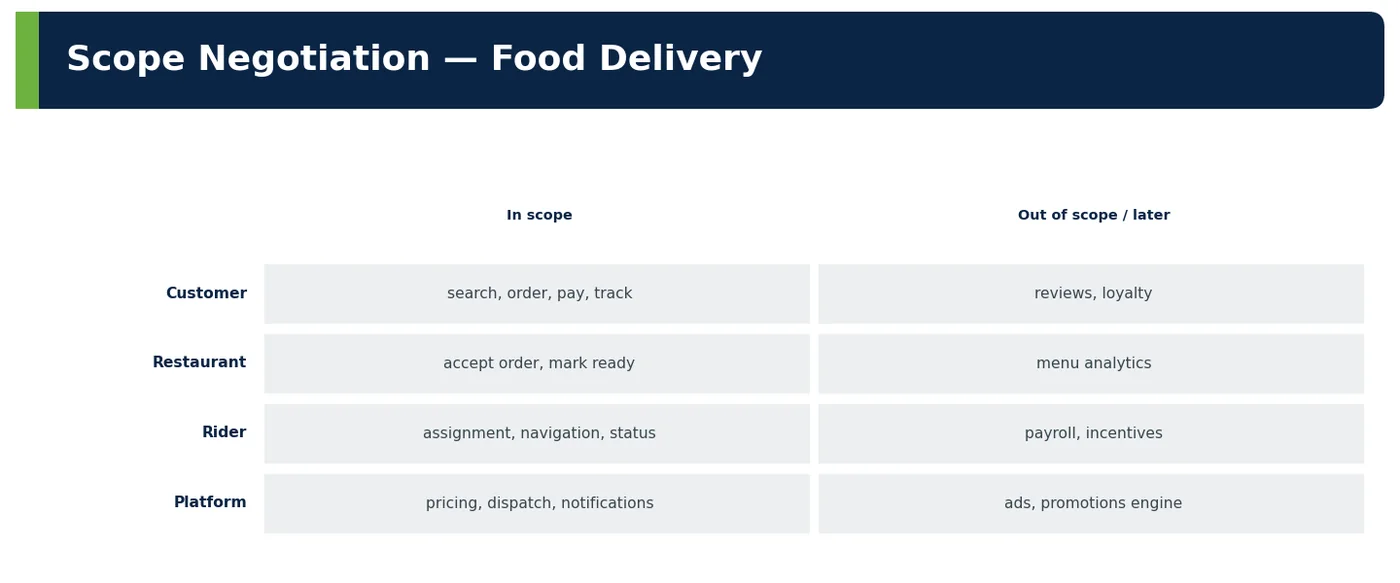
| Scope | What will we design today? | Ordering to delivery; not rider payroll, ads or reviews |
| Success | How do we know it works? | Orders/min, delivery time, availability, order accuracy |
The funnel works because each level narrows the next. Once actors are known, use cases follow; once the critical path is known, scope negotiation becomes easy — anything off the critical path is a candidate for "later".
4How It Works Internally — A Clarification Script
| Minute | Move | Example phrasing |
|---|---|---|
| 0–1 | Restate the prompt | "So we're designing a platform where customers order food from restaurants and riders deliver it." |
| 1–3 | Actors and use cases | "The main actors I see are customers, restaurants and riders — is support in scope?" |
| 3–4 | Find the hard part | "The tricky part seems to be real-time dispatch and tracking at lunch peaks — is that where you'd like depth?" |
| 4–5 | Negotiate scope | "I'll focus on order → delivery and treat payments as a provider integration; reviews and ads out of scope." |
| 5–6 | Success and scale (handover to 1.4 / 2.3) | "Roughly how many orders per day, and what delivery-time target?" |
| 6–7 | Confirm | "Let me write this scope box… does that match what you had in mind?" |
4ADeep Dive — Finding the Hard Part
Every good prompt has one or two aspects that make it genuinely hard. Naming them early shows seniority and focuses the rest of the interview.
| Prompt | Likely hard part(s) |
|---|---|
| Food delivery | Rider dispatch and ETA at peak; order state across three parties |
| Payment system | Exactly-once money movement; reconciliation; PCI scope |
| URL shortener | Unique ID generation at scale; hot-key reads |
| Ticket booking | Seat contention during hot on-sales; fairness; bots |
| Chat | Fan-out, ordering and presence at scale |
| Video streaming | Delivery bandwidth and encoding pipeline cost |
Ask about the hard part as a question, not a declaration: "I think seat contention during big on-sales is the hard part — is that where you'd like me to go deep?" The interviewer may redirect you, which is valuable information.
4BDeep Dive — Negotiating Scope
| Technique | Example |
|---|---|
| P0 / P1 / P2 | "P0: order and track. P1: scheduled orders. P2: group orders." |
| In / out box | Written on the board, referred to later |
| Treat as black box | "Payments via a PSP; I'll show the integration, not the PSP internals." |
| Defer with a hook | "Recommendations later — I'll leave an event stream they can consume." |
| Ask for preference | "Would you rather I go deep on dispatch or on payments?" |
4CDeep Dive — Functional vs Non-Functional Clarification
| Functional (what) | Non-functional (how well) |
|---|---|
| Customers can order from one restaurant at a time | Order placement p99 < 1 s |
| Restaurants can accept or reject within 3 minutes | 99.95% availability during 11:00–15:00 and 19:00–23:00 |
| Riders see assigned orders and navigation | Location updates every 5 s for active riders |
| Customers see live rider location | ETA accuracy ± 5 minutes for 90% of orders |
Candidates often clarify only functions. Ask at least two non-functional questions (scale and one quality attribute) in the first minutes; they will change the design more than any feature.
4DDeep Dive — System Design vs Solution Architect Interviews
| Aspect | System design interview | Solution architect interview |
|---|---|---|
| Focus | Components, scale, data, algorithms | Business context, stakeholders, constraints, delivery |
| Clarification adds | Traffic and data numbers | Business goals, existing systems, regulation, team, budget |
| Typical extra questions | "How many users?" | "What problem does the business need solved? What exists today? Who decides?" |
| Expected output | Scalable design | Fit-for-purpose solution with roadmap and trade-offs |
In a solution architect interview, ask about existing systems and business outcomes early: "Is this greenfield, or do we integrate with an existing order system?" often changes the design more than traffic numbers.
4EDeep Dive — Recovering From a Misunderstanding
| Signal | Recovery |
|---|---|
| Interviewer asks about something you declared out of scope | "Let me bring that into scope — here's how it attaches." |
| Interviewer's numbers differ from your assumption | Update the scope box and say what changes in the design |
| You realise the hard part was different | Say so explicitly and re-prioritise remaining time |
| You over-scoped and are running out of time | "I'll summarise the remaining areas briefly and go deep on X." |
4FDeep Dive — Time-Boxing
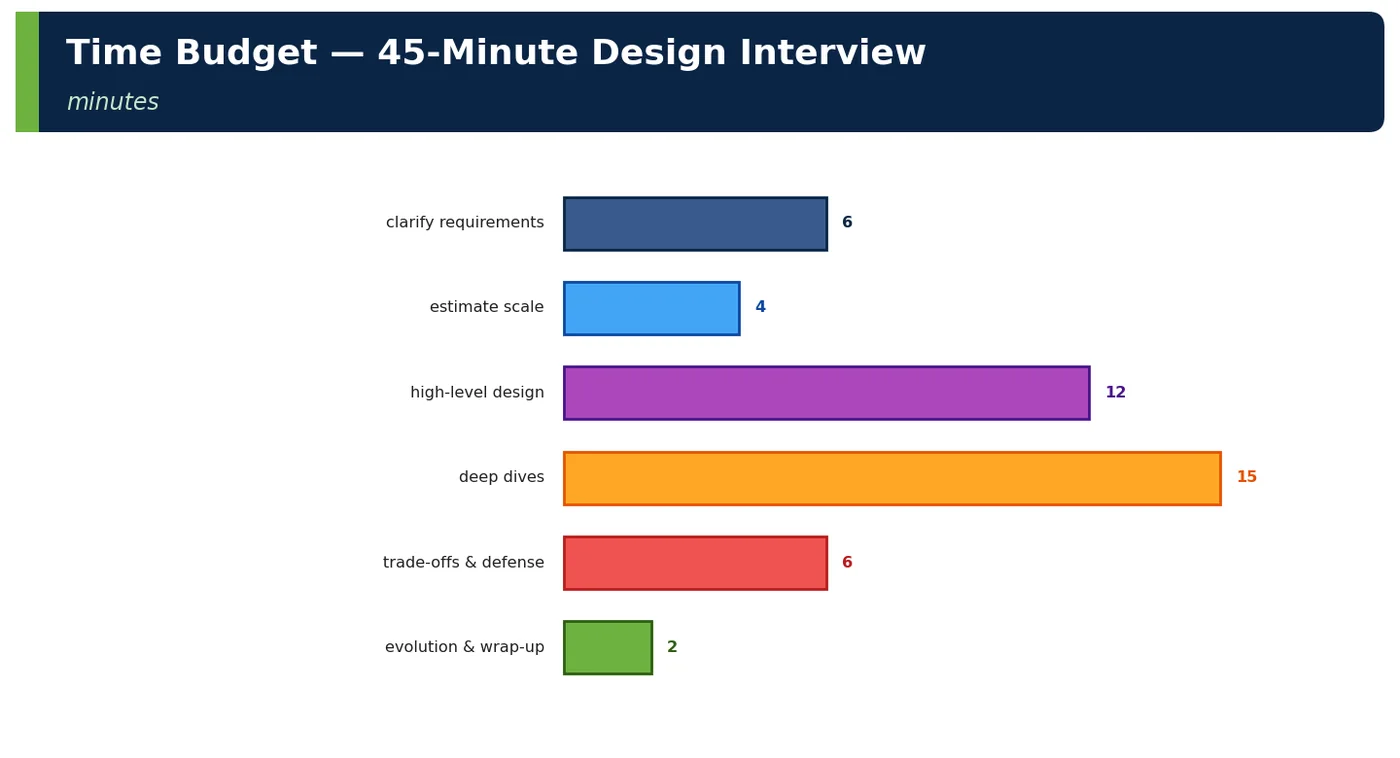
| Interview length | Clarification budget |
|---|---|
| 45 minutes | 5–6 minutes |
| 60 minutes | 6–8 minutes |
| 90-minute solution architect case | 10–15 minutes (more stakeholder context) |
| Rule | Stop when you can write the scope box and the top numbers |
5APIs / Features / Syntax
SCOPE BOX (written top-left of the whiteboard) — QuickBite food delivery
Actors: customers · restaurants · riders · (support: out)
P0: browse → order → pay (PSP) → restaurant accepts → rider assigned → track → deliver
P1: scheduled orders, cancellations/refunds
Out: reviews, ads, rider payroll, restaurant onboarding UI
Hard part: dispatch + live tracking at lunch/dinner peaks
Success: 1M orders/day; peak 400 orders/s; 99.95% ordering; ETA ±5 min for 90%RESTATEMENT (say it, then pause)
"To confirm: we're designing the ordering-to-delivery path for a food delivery platform
across customers, restaurants and riders, at about a million orders a day with sharp
meal-time peaks. Payments go through a provider. The part you'd like depth on is dispatch
and tracking. Reviews, ads and payroll are out. Does that match your expectations?"CLARIFICATION CHECKLIST (mental)
[ ] actors named [ ] critical path identified
[ ] hard part confirmed [ ] scope box written (in/out/P0-P2)
[ ] 1–2 scale numbers [ ] 1–2 quality targets
[ ] greenfield or existing? [ ] restated and confirmed6Practical Examples
6.1 Strong opening — food delivery
A candidate restated the prompt, named four actors, asked whether support tools were in scope, proposed dispatch and tracking as the hard part and wrote a scope box by minute six. The interviewer later said the design felt "aimed" — every component had a reason tied to the box.
6.2 Weak opening — payment system
Another candidate began drawing an API gateway and microservices within a minute. At minute twenty the interviewer asked about marketplace payouts; the design had no ledger and no split payments. The candidate never recovered the lost time.
6.3 Solution architect case — existing systems
In a 90-minute case, a candidate asked "What exists today?" and learned that a legacy order system handled 70% of volume and could not be replaced for two years. The design shifted from greenfield to strangler — the interviewer's intended hard part.
6.4 Worked example — clarification dialogue (payment system)
Scenario. A candidate is asked to "design a payment system" with no other detail, and has about six minutes before the design discussion should begin.
| Candidate asks | Interviewer answers | Design impact |
|---|---|---|
| "Who pays whom — a merchant checkout or a marketplace?" | "Marketplace: buyers pay, sellers get paid out." | Ledger with splits and payouts |
| "Which methods?" | "Cards and UPI; wallets later." | PSP adapters; tokenisation |
| "Peak volume?" | "Sale days: 5,000 payments/s." | Async processing; idempotency; partitioning |
| "Do we hold funds?" | "Escrow until delivery." | Ledger states; reconciliation |
| "Regulatory scope?" | "India; RBI payment aggregator rules." | Data localisation; PCI via PSP |
What it shows. Five well-chosen questions turn a vague prompt into concrete design constraints. Learning that it is a marketplace means the ledger must handle splits between sellers and payouts. Cards and UPI, with wallets later, call for adapters per payment service provider and tokenisation. A peak of 5,000 payments per second on sale days calls for asynchronous processing, idempotency keys and partitioning. Holding funds in escrow until delivery adds ledger states and daily reconciliation. Operating in India under RBI payment aggregator rules requires data localisation and keeping card data with a PCI-compliant provider. Each answer is written on the board next to its design impact, so the interviewer can see how the questions shaped the design.
Common mistake. Asking generic questions, such as "how many users?", without explaining how each answer will change the design.
Takeaway. Ask a few questions whose answers change the design, and connect each answer to its design consequence.
6.5 Worked example — finding the hard part (URL shortener)
Scenario. A candidate is asked to design a URL shortener, a prompt that sounds simple and invites a generic answer.
| Candidate move | Why it's strong |
|---|---|
| "Writes are small; reads dominate — maybe 100:1?" | Targets the read path |
| "Is custom alias support needed?" | Affects ID generation |
| "Do links expire? Analytics?" | Storage and event pipeline |
| "I think ID generation without collisions at scale and hot links are the hard parts." | Names depth areas |
What it shows. Focused clarification finds where the real difficulty lies. Checking that reads dominate writes, perhaps 100 to 1, points the design towards fast reads and caching. Asking about custom aliases affects how IDs are generated and checked for conflicts. Asking about link expiry and analytics affects storage and whether an event pipeline is needed. The candidate then names the hard parts: generating unique IDs without collisions at scale, and handling very popular "hot" links. Naming them tells the interviewer where the deep dive will go and shows judgement, rather than spending the interview on easy parts.
Common mistake. Treating a short prompt as trivial and never finding the parts that make it hard.
Takeaway. Use clarification to find and name the hard parts, then spend your depth there.
6.6 Worked example — scope negotiation (ticket booking)
Scenario. A candidate designing a ticket booking system has 45 minutes, far too little to cover every feature.
| Area | Decision |
|---|---|
| Browse, seat map, hold, pay, ticket | In (P0) |
| Virtual queue for hot on-sales | In (P1) — hard part |
| Organiser portal | Out — assume events exist |
| Resale marketplace | Out — mention as evolution |
| Dynamic pricing | Out |
What it shows. Scope negotiation produces a clear scope box. Browsing events, the seat map, holding seats, payment and ticket issue form the P0 path, which must work. A virtual queue for very popular on-sales is P1 and is chosen as the hard part, because it prevents the system from collapsing when thousands of fans arrive at once. The organiser portal is out of scope, with events assumed to exist. A resale marketplace and dynamic pricing are out, mentioned only as future evolution. The interviewer agrees, and the remaining time goes into designing the core path and the queue properly.
Common mistake. Trying to include every feature, leaving no time to design any of them well.
Takeaway. Negotiate a scope box with clear priorities, and write it down where both sides can see it.
6.7 Worked example — interview whiteboard
Scenario. In interviews, candidates are asked: "You have 45 minutes to design a food delivery platform. How do you start?"
| Prompt | Answer outline |
|---|---|
| "You have 45 minutes: design a food delivery platform. How do you start?" | "Restate the prompt. Name actors (customers, restaurants, riders, support?). Identify use cases and the critical path (order → accept → dispatch → deliver). Propose the hard part (dispatch and tracking at peaks) and ask if that's where to go deep. Negotiate scope (P0/P1/out) and write a scope box. Ask 1–2 scale questions and 1–2 quality targets, or state assumptions. Restate and confirm. Budget ~6 minutes, then move to estimation and design." |
Why it works. The outline gives a disciplined opening. The candidate restates the prompt, names the actors, such as customers, restaurants, riders and possibly support staff, and identifies the critical path: order, accept, dispatch, deliver. They propose the hard part, rider dispatch and live tracking at peak times, and check that the interviewer wants depth there. They negotiate scope into P0, P1 and out-of-scope items, ask one or two questions about scale and quality targets or state assumptions, then restate and confirm. About six minutes are used before moving on to estimation and design.
Common mistake. Spending fifteen minutes on questions, or starting to draw services in the first minute.
Takeaway. Use a short, structured clarification routine and keep to a time budget.
6.8 Worked example — recovering
Scenario. Partway through a food delivery design, the interviewer introduces new information that changes the picture.
| Moment | Candidate response |
|---|---|
| Minute 18: "What about group orders?" | "I scoped that as P2; if it's important I'll add a cart-sharing service that creates one order — here's where it attaches." |
| Minute 25: "Actually, 10M orders/day." | "That's 10× my assumption; dispatch must be partitioned by city and the order store sharded — let me update the numbers." |
What it shows. Good candidates adjust openly and quickly. At minute 18, when asked about group orders, the candidate points to the scope box where they were placed as P2, then shows where a cart-sharing service would attach to create one combined order. At minute 25, when told the platform handles 10 million orders a day, ten times the assumption, the candidate updates the numbers on the board and explains the consequences: dispatch must be partitioned by city and the order store sharded. Interviewers value this ability to absorb change calmly.
Common mistake. Ignoring the new information, or restarting the whole design from the beginning.
Takeaway. When requirements change, update the scope and numbers visibly and explain what changes in the design.
6.9 Worked example — anti-patterns spotted by interviewers
Scenario. Interviewers at large technology companies use common notes to evaluate how candidates handle clarification.
| Anti-pattern | What the interviewer notes |
|---|---|
| 20 questions before any design | "Can't prioritise; stalls" |
| No questions at all | "Assumes; may design wrong thing" |
| "What should I design?" | "Pushes work to interviewer" |
| Silent assumptions | "Didn't surface key decisions" |
| Scope creep | "Didn't manage time" |
What it shows. The table shows how each anti-pattern is judged. Asking twenty questions before any design suggests the candidate cannot prioritise and stalls. Asking no questions suggests they make assumptions and may design the wrong thing. Asking "what should I design?" pushes the work back to the interviewer. Making silent assumptions hides key decisions the interviewer wanted to discuss. Letting scope grow shows poor time management. Avoiding all five is often what separates a strong opening from a weak one.
Common mistake. Believing that more questions always look better.
Takeaway. Clarify efficiently: enough to shape the design, visible assumptions and controlled scope.
6.10 Worked example — solution architect variant questions
Scenario. A solution architect candidate receives a design prompt that resembles a real client engagement rather than a pure technical puzzle.
| Question | Why it matters in an SA interview |
|---|---|
| "What business outcome is this meant to change?" | Aligns design to value |
| "What systems exist that we must integrate or replace?" | Greenfield vs brownfield |
| "Who are the key stakeholders and who decides?" | Governance and trade-off owners |
| "Any regulatory or data-residency constraints?" | Deployment and data design |
| "Team size and skills? Timeline?" | Architecture style and build/buy |
What it shows. The variant questions add business and delivery context that system design interviews often skip. Asking what business outcome the system should change aligns the design with value. Asking which existing systems must be integrated or replaced reveals whether it is greenfield or brownfield. Asking who the key stakeholders are and who decides identifies governance and trade-off owners. Regulatory and residency constraints shape deployment and data design, and team size, skills and timeline influence architecture style and build-or-buy choices.
Common mistake. Answering a solution architect prompt as if it were only a scaling exercise.
Takeaway. In solution architect interviews, clarify business outcomes, existing systems, stakeholders, regulation and delivery constraints.
6.11 Worked example — success measures
Scenario. Candidates often finish clarification without agreeing how success will be judged.
| Prompt | Success measures agreed |
|---|---|
| Food delivery | Orders/min at peak, delivery time, ordering availability |
| Payments | Success rate, zero lost/duplicate payments, settlement accuracy |
| Chat | Message delivery latency, ordering, online presence accuracy |
| Ticket booking | Zero double-bookings, hold latency, fair queue |
What it shows. Success measures turn goals into testable targets. For food delivery, they include orders per minute at peak, delivery time and ordering availability. For payments, success rate, zero lost or duplicate payments and settlement accuracy. For chat, message delivery latency, correct ordering and accurate online presence. For ticket booking, zero double bookings, seat hold latency and a fair queue. Writing these on the board gives the design clear targets and shows the interviewer that the candidate thinks about verification.
Common mistake. Leaving quality goals vague, such as "fast and reliable", which cannot guide or test the design.
Takeaway. Agree a few measurable success criteria before designing.
6.12 Worked example — real engagement parallel
Scenario. A candidate asks whether interview clarification has anything to do with real architecture work.
| Interview step | Real discovery workshop equivalent |
|---|---|
| Restate prompt | Problem statement agreed with sponsor |
| Actors, use cases | Stakeholder map and journey mapping |
| Hard part | Key risks and architecturally significant requirements |
| Scope box | Scope statement and MoSCoW backlog |
| Success measures | Business KPIs and NFR targets |
What it shows. Each interview step has a real discovery equivalent. Restating the prompt corresponds to agreeing a problem statement with the sponsor. Naming actors and use cases corresponds to stakeholder mapping and journey mapping. Finding the hard part corresponds to identifying key risks and architecturally significant requirements. The scope box corresponds to a scope statement and a MoSCoW-prioritised backlog, and success measures correspond to business KPIs and non-functional targets. The interview is the same skill compressed into minutes.
Common mistake. Treating interview technique as a trick unrelated to real work.
Takeaway. Practise clarification as a real architecture skill; interviews test it in compressed form.
7Common Problems & Mistakes
| Mistake | Fix |
|---|---|
| Drawing in minute one | Restate and clarify first |
| Endless questions | Time-box; assume and state the rest |
| Only functional questions | Add scale and one quality target |
| No written scope | Scope box on the board |
| Hard part missed | Ask "where would you like depth?" |
8Performance & Production Considerations
| Consideration | Clarification question |
|---|---|
| Peak vs average | "Are there sharp peaks — meal times, sales, launches?" |
| Latency sensitivity | "Which interaction must feel instant?" |
| Availability windows | "Is 24×7 needed or business hours?" |
| Data growth | "How long do we keep history?" |
9Architecture & Design Considerations
| Guideline | Detail |
|---|---|
| Scope before structure | Design what was agreed |
| Name the hard part | Depth where it matters |
| Write it down | Board is shared memory |
| Confirm | Restatement prevents drift |
10Interview Questions & Answers
Why are interview prompts vague?
Interview prompts are deliberately vague, such as "design a payment system", to test whether the candidate can find and scope the real problem before solving it. In real work, requirements are rarely complete, and architects must discover who the users are, what matters most, what scale and quality are needed and what constraints apply. A candidate who asks focused questions, states assumptions and agrees scope shows that skill. One who starts designing immediately often solves the wrong problem. The vagueness is part of the test, not a flaw in the question.
What should you clarify first?
Clarify the actors and the core use cases first: who uses the system and what they need to do. Then identify the critical path, the sequence of steps that must work for the system to deliver value, such as order, accept, dispatch and deliver for food delivery. These answers define what the design must cover. After that, ask about scale, quality targets and constraints, which determine how the core path should be built. Starting with actors and use cases also prevents the common mistake of designing infrastructure before knowing what it must support.
What is the "hard part" and why name it?
The hard part is the aspect of the problem that makes it genuinely difficult, such as generating unique IDs at scale for a URL shortener, preventing double bookings during a ticket on-sale, or dispatching riders in real time for food delivery. Naming it focuses the deep-dive time where it matters, shows the interviewer that you can see beyond standard building blocks and gives you a chance to confirm that it is where they want depth. Choosing the wrong hard part, or none, usually leads to a design that is broad but shallow, which interviewers rate lower than a focused design with real depth.
How long should clarification take?
Clarification should usually take about five to eight minutes of a 45 to 60 minute interview. That is enough to understand actors, use cases, the critical path, scale, key quality targets and scope, and to write a scope box. Spending much less risks designing the wrong thing; spending much more leaves too little time for design and deep dives. Watching the clock and stating when you are moving on shows good time management. If the prompt is unusually ambiguous, a little longer is fine, as long as you explain why and keep moving towards design.
How do you negotiate scope?
Negotiate scope by prioritising features into P0, which must be designed; P1, which may be covered if time allows or is the chosen hard part; and P2 or out of scope. Write an in/out scope box on the board. Treat commodity components, such as email delivery or authentication, as black boxes. For deferred features, mention the hook where they would attach later. Confirm the scope with the interviewer before designing. Good scope negotiation is collaborative: you propose priorities with reasons, and the interviewer adjusts them. The agreed scope then guides every later decision and protects your time.
What if the interviewer says "you decide"?
When the interviewer says "you decide", state reasonable assumptions with numbers, such as 10 million daily users, 5,000 requests per second at peak and p99 latency under 300 ms, and write them on the board. Briefly explain why they are reasonable. Then proceed with the design. If the interviewer later corrects an assumption, update it visibly and explain how the design changes. This shows decisiveness and transparency. Avoid asking the interviewer to choose for you repeatedly, because making sensible assumptions is part of what is being assessed. Clear, numbered assumptions also make your estimates easy to follow and check.
How does clarification differ in a solution architect interview?
In a solution architect interview, clarification goes beyond scale and features. It also covers the business outcome the solution must change, existing systems to integrate or replace, key stakeholders and decision makers, regulatory and data residency constraints, team size and skills, budget and timeline. These factors shape architecture style, build-or-buy decisions, migration approach and governance, and they reflect the broader responsibilities of the role. Asking these questions shows that you think about the whole solution, including people, process and delivery, not only the technology. Interviewers for solution architect roles expect this broader view.
How do you recover from a misunderstanding?
Acknowledge the misunderstanding calmly and without excessive apology. Update the scope box or assumptions on the board, so the change is visible. Explain which parts of the design are affected and what changes, for example adding a component or partitioning a store, and which parts remain valid. Then continue. Interviewers value candidates who adapt quickly and transparently, because requirements change frequently in real projects. Recovering well can even strengthen an interview, because it shows the composure and flexibility expected of senior architects. Keep the scope box current so the interviewer can see exactly what changed.
What is the whiteboard output of clarification?
The visible output of clarification is a scope box on the whiteboard. It lists the actors, the P0 critical path, the items explicitly out of scope, the chosen hard part and the agreed success measures, along with key assumptions about scale and quality targets. The box acts as a contract with the interviewer and a reference throughout the design, helping both sides stay focused and track any changes. A clear scope box also makes the final summary easy, because you can show how the design meets each item.
How does this mirror real work?
Interview clarification is a compressed version of a real discovery workshop. Restating the prompt mirrors agreeing a problem statement with the sponsor; actors and use cases mirror stakeholder and journey mapping; the hard part mirrors identifying key risks and architecturally significant requirements; the scope box mirrors a scope statement and prioritised backlog; and success measures mirror business KPIs and non-functional targets. The same skill applies in both settings. Practising clarification in interviews therefore also improves real discovery work, and experience in real discovery makes interview clarification feel natural.