Apply each principle as concrete, testable design practices, combine them without contradiction, avoid fail-open behaviours, design independent control layers, and embed secure-by-design practices into delivery
Covers
Least privilege · Defense in depth · Fail secure · Zero trust · Secure by design
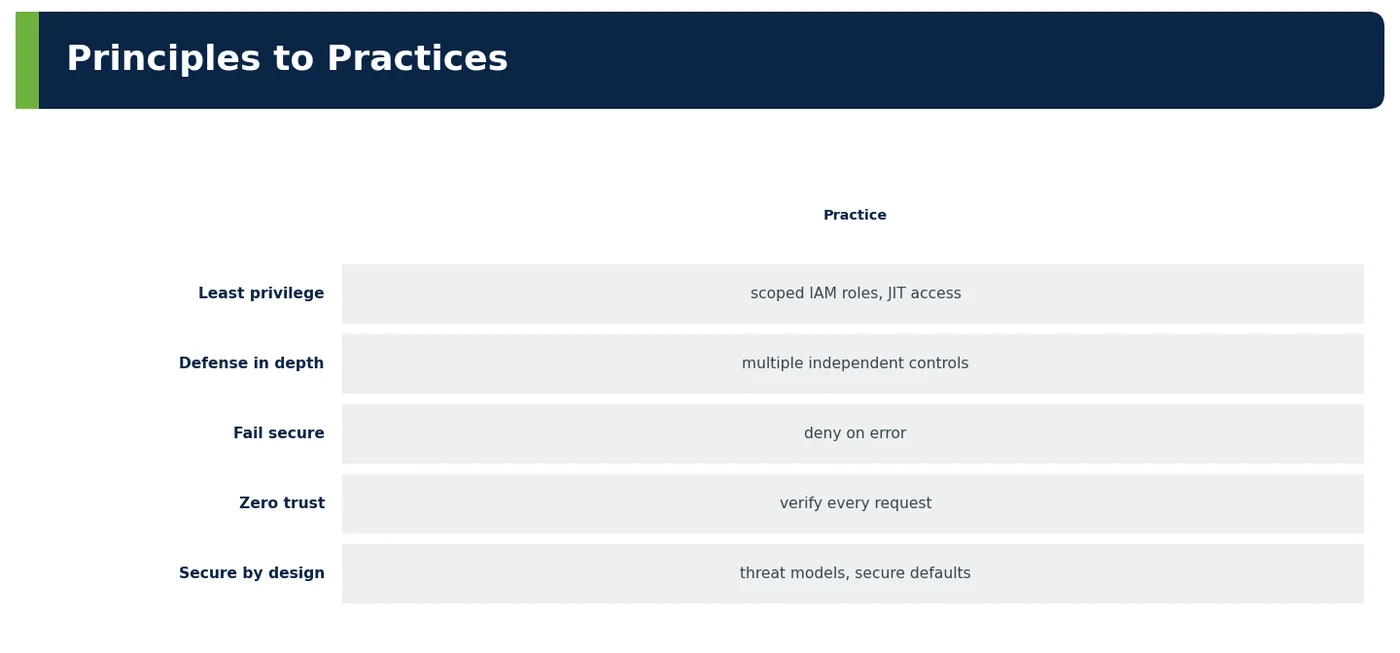
Security principles are design rules that guide every security decision regardless of technology. Five are central to modern architecture: least privilege (minimum access for minimum time), defense in depth (multiple independent control layers), fail secure (errors default to a safe state), zero trust (never trust implicitly; verify every request) and secure by design (security built in from the start through threat modeling and secure defaults).
Figure 1 — Principles to practices
Figure 2 — Defense in depth
Vocabulary
Meaning
Privilege creep
Accumulation of unnecessary permissions over time
Common-mode failure
One flaw defeating multiple layers
Fail open
Allowing access when a control fails
Secure default
Safe configuration without extra effort
Table 1 — Terms
2Why It Exists
Violation
Consequence
Over-privileged service role
Breach escalates to all data
Single control layer
One bypass = full compromise
Fail-open authorization
Outage becomes breach
Implicit network trust
Lateral movement
Security bolted on late
Expensive redesigns
Table 2 — Why
3Core Concepts — The Five Principles
Principle
Practices
Least privilege
Scoped IAM roles per service; OAuth scopes; JIT admin; no standing prod access; periodic reviews; Access Analyzer
Deny on authZ errors; closed circuit for security checks; generic error messages
Zero trust
Authenticate every request; mTLS; context-aware policies; micro-segmentation
Secure by design
Threat models; secure templates; security in definition of done; memory-safe frameworks
Table 3 — Practices
4How It Works Internally — Least Privilege in Layers
Layer
Implementation
Human
Identity Center permission sets; JIT elevation 1 h; quarterly reviews
Service → AWS
One IAM role per service, resource-scoped ARNs, conditions
Service → service
Mesh AuthorizationPolicy by identity
Token
Scopes and audience per API; short lifetimes
Data
Row-level security; column masking for support roles
Time
Temporary credentials, expiring grants
Table 4 — Least privilege everywhere
4ADeep Dive — Defense in Depth Done Right
Guideline
Detail
Independent layers
Different mechanisms, owners and failure modes
Avoid common-mode
Don't rely on one IdP config for all layers
Detect when a layer fails
Monitoring as a layer
Don't stack useless layers
Each must reduce risk measurably
Example
WAF blocks SQLi patterns, but code uses parameterised queries anyway
Table 5 — Layers that actually help
4BDeep Dive — Fail Secure
Figure 3 — Fail open vs fail secure
Situation
Fail-secure behaviour
Authorization service unreachable
Deny (with cached decisions for low-risk reads if policy allows)
Token validation error
401, no partial access
Exception during permission check
Deny, log
Feature flag service down
Default to safe (feature off)
Crypto library error
Abort operation
Error messages
Generic to user, detailed in secure logs
Table 6 — Default to deny
4CDeep Dive — Zero Trust as a Principle
Tenet
Practice
Verify explicitly
Identity, device, context every time
Least privilege
Per-request scopes, JIT
Assume breach
Segment, encrypt, monitor, limit blast radius
Applied to
Users, workloads, networks, data (Chapter 5 details)
Table 7 — Zero trust in brief
4DDeep Dive — Secure by Design
Practice
Detail
Threat modeling in design phase
Chapter 7
Secure defaults in templates
Deny-all security chains, TLS, encryption
Paved roads
Platform modules with controls built in
Secure frameworks
Spring Security, parameterised JPA, auto-escaping templates
Security requirements in stories
Acceptance criteria
Eliminate classes of bugs
E.g. no native deserialization, no string-built SQL
Transparency
SBOMs, vulnerability disclosure
Table 8 — Build it in
4EDeep Dive — Principle Conflicts and Balance
Tension
Resolution
Least privilege vs developer velocity
Self-service JIT, permission boundaries
Fail secure vs availability
Separate safety of decision from availability of service (degraded read-only)
Defense in depth vs complexity
Only layers with measurable value
Zero trust vs latency
Efficient mTLS, cached decisions
Table 9 — Practical balance
5APIs / Features / Syntax
JAVA
// Fail secure: any error in the authorization decision results in denialpublic boolean canApprove(User user, Transfer transfer) {try {return pdp.isAllowed(user, "transfer:approve", transfer) && !transfer.createdBy().equals(user.id()); // separation of privilege } catch (Exception e) { log.atError().setCause(e).addKeyValue("transfer", transfer.id()) .log("authorization decision failed - denying");returnfalse; // deny on error }}
JSON
// Least privilege IAM for a service: one bucket prefix, one KMS key, TLS-only{ "Version": "2012-10-17", "Statement": [{ "Effect": "Allow", "Action": ["s3:GetObject"], "Resource": "arn:aws:s3:::novabank-statements/customer-docs/*", "Condition": { "Bool": { "aws:SecureTransport": "true" } } }, { "Effect": "Allow", "Action": ["kms:Decrypt"], "Resource": "arn:aws:kms:ap-south-1:111122223333:key/statements-key-id" }]}
YAML
# Secure by design: CI policy fails on wildcard IAM actions (Checkov custom check config)metadata: id: CKV2_NB_1 name: "No wildcard actions in IAM policies" category: IAMdefinition: cond_type: attribute resource_types: [aws_iam_policy] attribute: policy.Statement[*].Action operator: not_contains value: "*"
6Practical Examples
6.1 Least privilege reduced breach impact
In a red-team exercise, a compromised statements service could read only its S3 prefix and decrypt with one key — no customer database access, no other buckets.
6.2 Fail-open bug fixed
A legacy entitlement check returned "allow" when the entitlement service timed out. Changing it to deny with a cached read-only fallback removed a critical risk.
6.3 Secure-by-design templates
ShopNow's service scaffold includes deny-all Spring Security, JWT validation, actuator lockdown, structured security logging and OWASP dependency checks — new services start secure.
6.4 Worked example — privilege review
Finding
Action
Role unused permissions (Access Analyzer)
Removed 38 actions
Table 10 — Fight privilege creep
6.5 Worked example — defense layers for SQLi
Layer
Control
Edge
WAF SQLi rule
App
Parameterised queries
DB
Least-privilege DB user
Monitor
Anomaly alerts
Table 11 — Independent layers
6.6 Worked example — JIT access
Request
Grant
Prod DB read for incident
1 hour, approved, recorded
Table 12 — Time-bound privilege
6.7 Worked example — interview whiteboard
Prompt
Answer outline
"Which security principles guide your designs and how?"
"Least privilege (scoped roles, scopes, JIT, reviews), defense in depth (independent layers edge→data→monitoring, avoid common mode), fail secure (deny on errors, safe defaults, generic messages), zero trust (verify every request, mTLS, context, segmentation, assume breach), secure by design (threat models, secure defaults, paved roads, eliminating bug classes). Make each testable (CI checks, Config rules, tests) and balance with usability and availability."
Table 13 — Structured answer
6.8 Worked example — PayGrid scopes
Client
Scopes
Merchant reporting app
payments:read only
Table 14 — Least privilege for tokens
6.9 Worked example — anti-patterns
Anti-pattern
Effect
Admin roles for convenience
Large blast radius
Layers sharing one weakness
False sense of depth
catch (Exception) → allow
Fail open
Security review at the end
Late, costly changes
Table 15 — Common mistakes
6.10 Worked example — NovaBank zero trust
Change
Detail
VPN replaced by Verified Access
Per-app, device-aware access
Table 16 — Principle in action
6.11 Worked example — secure defaults
Default
Where
Encryption on, public access blocked
Landing zone baseline
Table 17 — Default safe
6.12 Worked example — degraded mode
Dependency failure
Mode
Fraud service down
Low-value transfers allowed with limits; high-value denied
Table 18 — Fail secure with business continuity
6.13 Worked example — error handling
Response
Content
User
"Unable to process request" + correlation ID
Logs
Full detail
Table 19 — No leakage
6.14 Worked example — eliminating a bug class
Change
Effect
Ban Java native deserialization via ArchUnit rule
Removes gadget-chain risk
Table 20 — Systemic fix
6.15 Worked example — measuring principles
Metric
Target
Wildcard IAM policies
0
Standing admin users
0
Services with deny-all default
100%
Table 21 — Testable principles
6.16 Worked example — interview follow-ups
Follow-up
Answer
"Fail secure vs availability?"
Deny unsafe actions; design degraded modes for availability
"Is defense in depth just more tools?"
No — independent, meaningful layers
Table 22 — Common probes
6.17 Worked example — checklist
Item
✔
Least privilege enforced + reviewed
✔
Independent layers
✔
Fail-secure code paths
✔
Zero-trust access
✔
Secure-by-design templates
✔
Metrics
✔
Table 23 — Principles baseline
6.18 Worked example — separation of duties
Action
Rule
Deploy to prod
Author ≠ approver
Table 24 — Integrity of change
6.19 Worked example — least privilege for CI
Pipeline
Role
Service deploy
Only its namespace/account
Table 25 — Supply chain containment
6.20 Worked example — secure by design pledge items
Which principles does this design uphold or weaken?
Table 32 — Explicit reasoning
7Common Problems & Mistakes
Mistake
Fix
Over-privilege
Scoping + reviews
Correlated layers
Independence
Fail open
Deny on error
Late security
Secure by design
Table 33 — Mistakes and fixes
The most damaging mistakes are usually quiet ones. Privilege creep happens because access is granted for a project or incident and never removed, so a role that started with five actions ends up with eighty; without Access Analyzer reviews and expiring grants nobody notices until a breach shows the blast radius. Correlated layers are the second trap: a WAF, an API gateway and the service may all trust the same identity provider configuration, so one misconfigured issuer defeats all three. Fail-open code is often written innocently, as a catch block that returns true so that an outage does not block customers. Finally, principles stated in a policy document but never turned into CI checks or tests decay within a few releases.
8Performance & Production Considerations
Consideration
Practice
Authorization latency
Local/embedded PDPs
mTLS overhead
Connection reuse
JIT friction
Fast approvals
Table 34 — Operating principles
Principles have a runtime cost, so design them to be cheap on the hot path. Calling a remote policy decision point on every request adds a network hop and a new dependency; embedding the policy engine as a library or sidecar with locally distributed policies keeps authorization latency to well under a millisecond, and short-lived cached decisions can cover low-risk reads. Mutual TLS is inexpensive once connections are reused and certificates are rotated automatically by the mesh or ACM Private CA. Just-in-time access only works in production if approvals take minutes rather than days, otherwise engineers find workarounds. Track adherence as operational metrics, such as wildcard policies, standing admin users and fail-secure test coverage, and alert when they drift.
9Architecture & Design Considerations
Guideline
Detail
Principles → practices → checks
Testable
Balance with usability
Adoption
Revisit in ADRs
Explicit
Table 35 — Design guidance
10Interview Questions & Answers
Q1BasicConcept
What is least privilege?
Least privilege means every identity, whether a person, service, pipeline or token, gets only the permissions it needs, on only the resources it needs, for only as long as it needs them. The goal is to limit blast radius: if a credential is stolen, the attacker can do very little with it. In practice that means one IAM role per service scoped to specific ARNs and conditions, OAuth scopes and audiences per API, database users that cannot run DDL, and no standing production admin access. Time matters as much as scope, so temporary credentials and just-in-time elevation that expires after an hour are part of the principle, not an extra.
Q2BasicConcept
What is defense in depth?
Defense in depth means protecting an asset with several independent layers of control, so that the failure or bypass of one layer does not lead straight to compromise. A typical stack runs from the edge, with a WAF and DDoS protection, through network segmentation, strong identity with MFA, application-level authorization and input validation, to data encryption and finally monitoring that detects when a layer has failed. The key word is independent: layers should use different mechanisms, owners and failure modes. A WAF rule against SQL injection is useful, but the code must still use parameterised queries and the database user must still lack rights to drop tables.
Q3IntermediateConcept
What does fail secure mean?
Fail secure means that when a security control or one of its dependencies fails, the system defaults to the safe state, which is usually to deny. If the authorization service is unreachable, a token cannot be validated, or an exception is thrown during a permission check, the request is refused rather than allowed through. Feature flags for risky capabilities default to off, and cryptographic errors abort the operation. Error messages to users stay generic, with a correlation ID, while the detail goes to secure logs so failures do not leak internals. The classic bug it prevents is a catch block that returns true, which turns an ordinary outage into a security breach.
Q4IntermediateConcept
What is zero trust?
Zero trust is the principle that no request is trusted because of where it comes from. Being inside the corporate network or the VPC grants nothing; every request from a user, device or workload is authenticated, authorized and evaluated against context such as device posture, location and risk. Its three tenets are verify explicitly, use least privilege per request, and assume breach, which drives segmentation, encryption everywhere and monitoring to limit lateral movement. In practice that looks like mTLS between services with mesh authorization policies, short-lived scoped tokens, and replacing broad VPN access with per-application access such as AWS Verified Access. It applies to users, workloads, networks and data alike.
Q5Senior EngineerConcept
What is secure by design?
Secure by design means security is built into a system from its first design decision rather than bolted on before go-live. It starts with threat modeling during design, so risks shape the architecture while changes are cheap. It continues with secure defaults that need no extra effort, such as a service template with deny-all Spring Security, TLS, encryption and locked-down actuator endpoints, and paved roads where the platform provides these controls ready-made. Mature teams also eliminate whole classes of bugs, for example banning native Java deserialization or string-built SQL with ArchUnit rules, and put security acceptance criteria in stories. CISA's Secure by Design pledge pushes vendors in the same direction.
Q6Senior EngineerDesign
How do you prevent privilege creep?
Privilege creep is prevented by making access expire and by measuring what is actually used. Grants for projects, incidents and vendors should be time-bound by default, through just-in-time elevation and expiring permission sets, so nothing accumulates silently. Unused-access analysis, such as IAM Access Analyzer's last-accessed data, shows which actions a role has never exercised, and those are removed; one review at NovaBank removed thirty-eight actions from a single role. Quarterly access reviews with named owners catch human accounts, and joiner, mover and leaver processes remove access when people change teams. Define roles in code, so every permission change goes through review and the policy history is auditable.
Q7Technical ArchitectTricky
What is a common-mode failure in defense in depth?
A common-mode failure is a single flaw that defeats several defensive layers at once because they share a mechanism, dependency or assumption. Defense in depth only works if layers fail independently. If the API gateway, the service and the admin console all validate tokens against one identity provider configuration, a mistake such as accepting an unsigned token or the wrong issuer breaks all three together. The same happens when several layers rely on one vendor library, one shared secret or one team's review. To avoid it, vary the mechanisms, separate ownership, keep controls such as database permissions that do not depend on the identity layer, and monitor each layer separately.
Q8Technical ArchitectTrade-off
How do you balance fail secure with availability?
Separate the safety of a decision from the availability of the service. Fail secure applies to the decision itself: if the control cannot reach a trustworthy answer, the risky action is denied. Availability is then protected by designing degraded modes in advance rather than by failing open. If the fraud service is down, low-value transfers can proceed within strict limits while high-value ones are refused or queued. If the policy engine is unreachable, cached decisions may allow low-risk reads for a short period. The business, risk and security owners should agree each degraded mode explicitly, document it in an ADR, and test it in game days so it behaves as intended.
Q9Solution ArchitectDesign
How do you make principles testable?
Turn each principle into concrete practices, and each practice into an automated check with a target. Least privilege becomes a CI policy, such as a Checkov rule, that fails the build on wildcard IAM actions, plus AWS Config rules for standing admin users. Fail secure becomes unit tests proving that an exception in the authorization path returns deny. Secure by design becomes ArchUnit rules banning native deserialization, and a template every new service must start from. Zero trust becomes mesh policies with default deny that are verified in tests. Then track the results as metrics on a dashboard, for example zero wildcard policies, zero standing admins and one hundred percent deny-all defaults.
Q10Solution ArchitectConcept
How do principles appear in documentation?
Principles appear in documentation mainly through architecture decision records. Every significant ADR should include a short section stating which security principles the design upholds or weakens and how any residual risk is handled. For example, an ADR introducing cached authorization decisions would note that it relaxes fail secure for low-risk reads, set a cache lifetime, and record who accepted the risk. Principles also belong in the architecture principles page with their measurable practices, in threat models linked from the design, and in service templates' documentation. Writing the reasoning down makes trade-offs reviewable by security and risk owners and stops individual developers making them silently in code.
Newsletter
Get new tutorials every week
New ArchitectMind tutorials and interview questions, once a week. No spam, unsubscribe anytime.
Your subscription could not be saved. Please try again.
Almost done! Check your inbox and click the confirmation link to complete your subscription.
 Architect