Explain point-to-point integration and why it is attractive initially, identify the forms of coupling it creates, quantify its scaling problems, recognise the symptoms of "spaghetti integration", decide when direct links remain acceptable, and plan a migration towards mediated integration
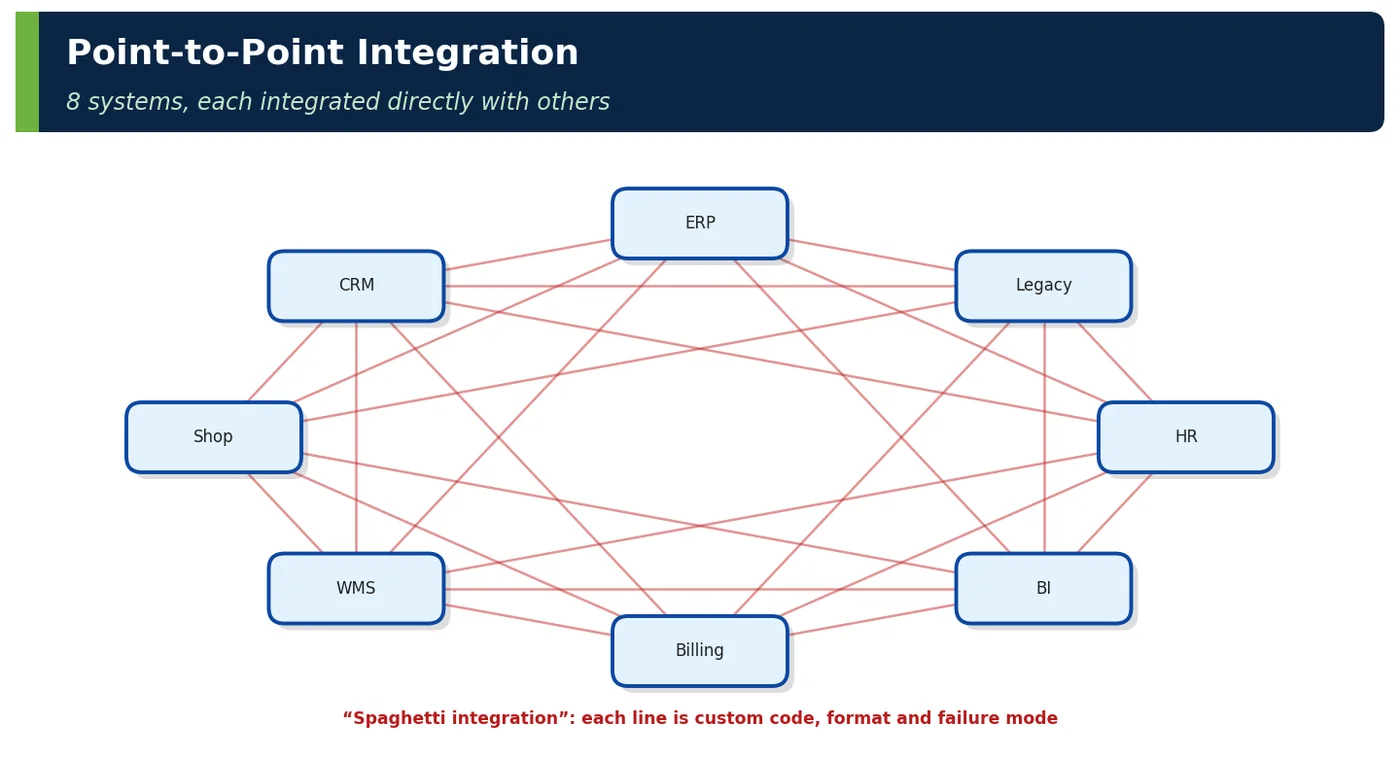
Point-to-point integration connects each pair of systems with a dedicated link — custom code, format and protocol per pair — without an intermediary.
Figure 1 — Point-to-point integration
TOC aspect
Definition
Direct connections
Each integration is a direct link between sender and receiver (API call, file drop, DB access, direct queue)
Coupling
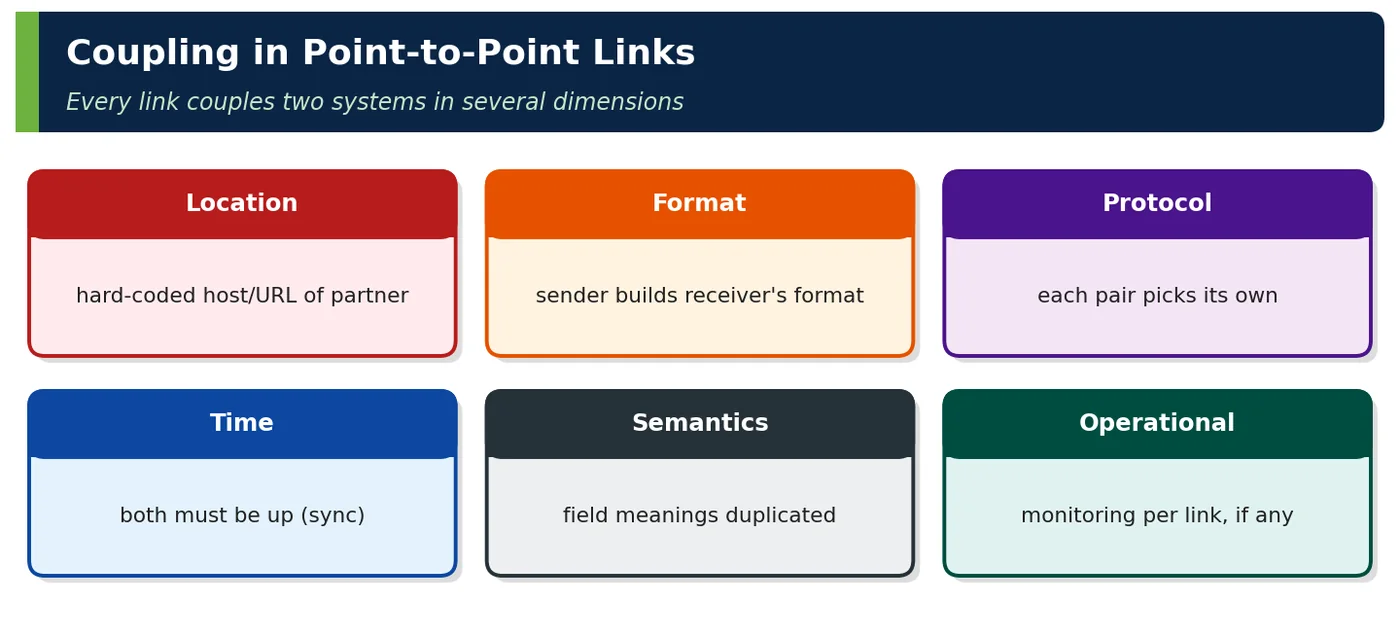
Each link binds the two systems in location, format, protocol, timing and semantics
Scaling problems
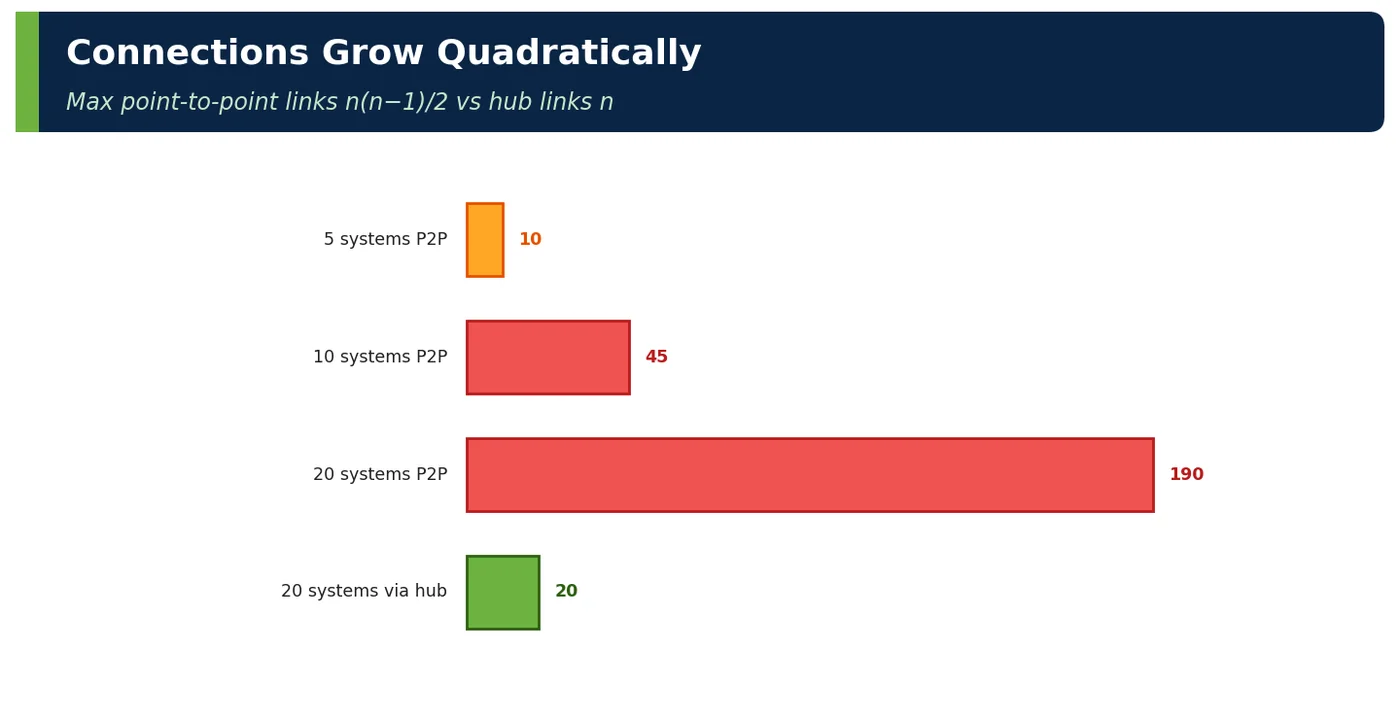
The number of links, mappings and failure modes grows roughly with the square of the number of systems
Table 1 — The three TOC aspects
2Why It Exists
Point-to-point integration arises naturally: a project needs data from another system and builds a direct connection. It's fast, needs no shared infrastructure and no central team. Repeated across years and teams, the landscape turns into a dense web that nobody fully understands.
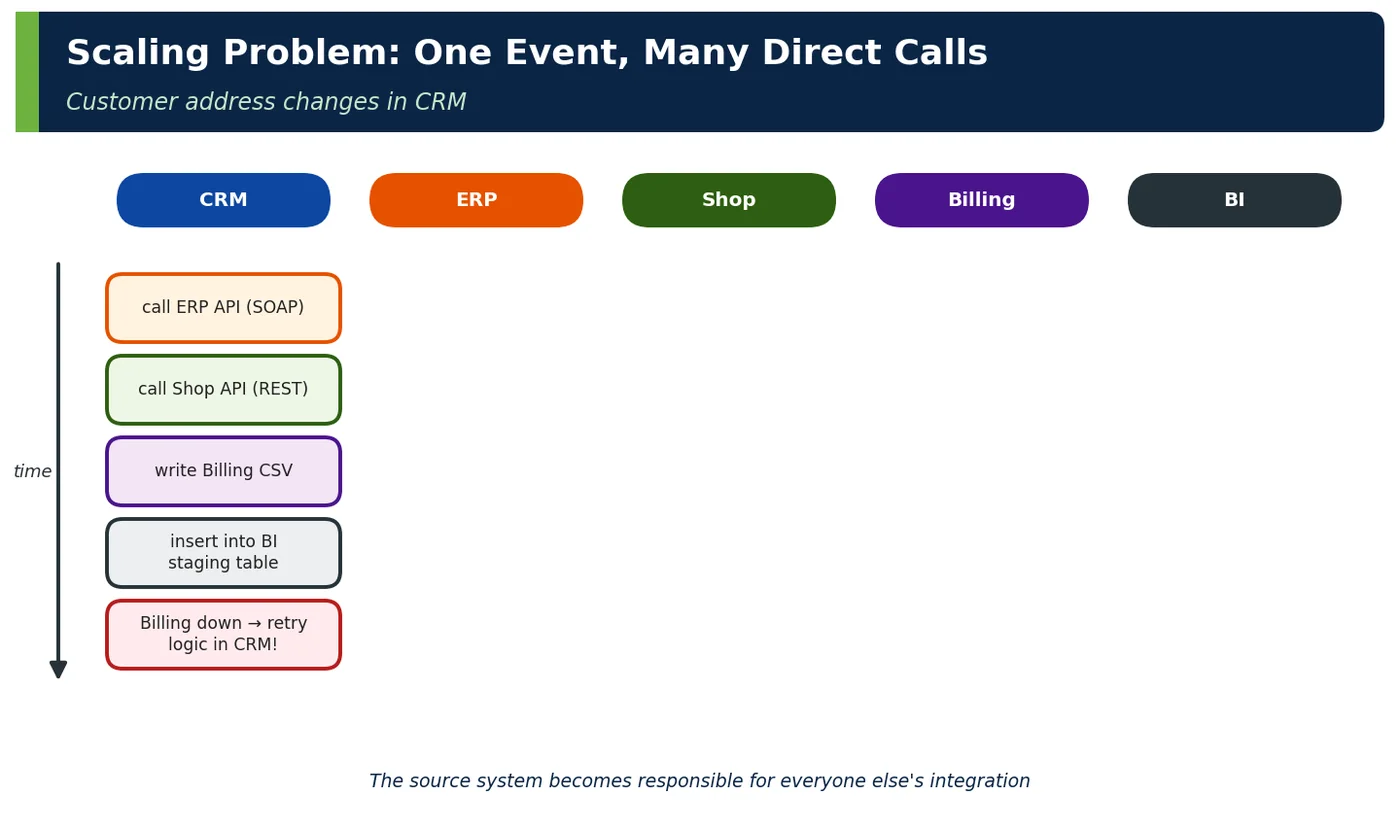
Figure 2 — Scaling problem: one event, many direct calls
3Core Concepts
3.1 Direct connections
Direct connection type
Example
Synchronous API
CRM calls ERP SOAP endpoint
File drop
ERP writes CSV to billing's SFTP folder
Database access
BI reads shop tables directly
Direct queue
Shop puts message on WMS's private queue
Embedded client library
Vendor SDK inside the calling app
Table 2 — Forms of direct connection
Initial advantages
Why teams choose it
Fast delivery
One team, one project
No shared platform
No dependency on integration team
Simple debugging (one hop)
Easy at small scale
Table 3 — Why P2P happens
3.2 Coupling
Figure 3 — Coupling in point-to-point links
Coupling dimension
Symptom when things change
Location
Receiver moves host → sender breaks
Format
Receiver changes schema → all senders change
Protocol
SOAP retirement forces sender rewrites
Time
Receiver outage fails sender's operation
Semantics
"status=3" meaning duplicated across senders
Table 4 — How direct links couple systems
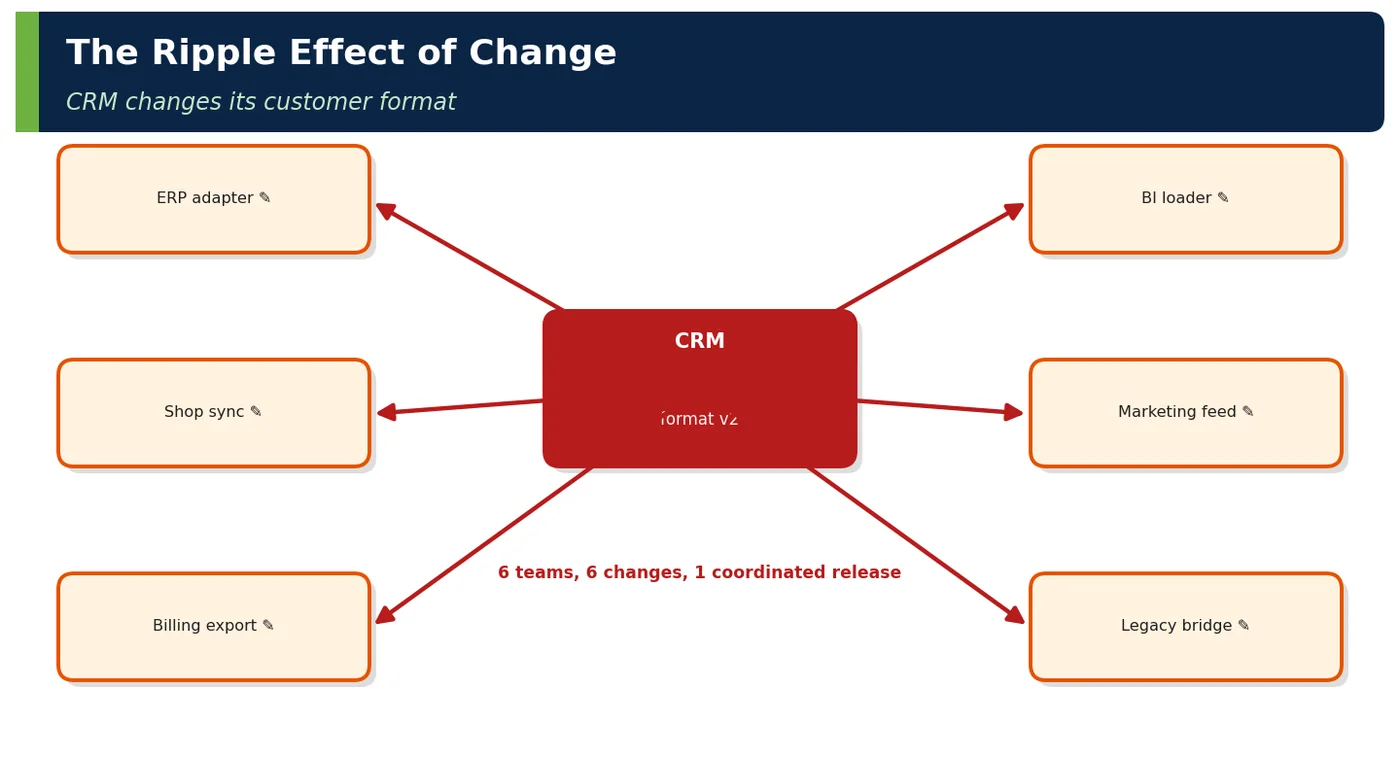
Figure 4 — The ripple effect of change
3.3 Scaling problems
Figure 5 — Connections grow quadratically
Scaling problem
Consequence
n(n−1)/2 potential links
20 systems → up to 190 integrations
Duplicated transformations
Same customer mapping written 10×
No central visibility
Unknown dependencies, surprise outages
Inconsistent error handling
Each link fails differently
Security sprawl
Credentials per link
Change cost
Replacing one system touches every link
Table 5 — Why P2P doesn't scale
4How It Works Internally — Anatomy of a Spaghetti Landscape
Observation (from an integration audit)
Typical finding
Links per system
CRM: 14 outbound, 6 inbound
Technologies
SOAP, REST, SFTP, DB links, JMS, email
Owners
40% unknown
Monitoring
25% have alerts
Documentation
Mostly in code
Table 6 — Audit metrics that reveal P2P debt
Symptom
Root cause
"We can't retire the old CRM"
Unknown direct consumers
Outage in one system cascades
Synchronous direct dependencies
Every project starts with integration discovery
No catalogue or mediation
Table 7 — Operational pain signals
4ADeep Dive — Migrating Away from Point-to-Point
Figure 6 — Point-to-point vs mediated integration
Step
Action
1. Discover
Catalogue all links (network flows, code search, DB grants, traces)
2. Prioritise
Entities with most consumers (customer, product, order)
3. Publish
Source system publishes events/API once (CustomerChanged)
4. Migrate consumers
Each consumer subscribes instead of direct link
5. Decommission
Remove direct links, revoke credentials
6. Govern
New integrations must use platform (with exceptions process)
Table 8 — Incremental untangling
JAVA
// Before: CRM pushes to four systems directly (P2P)void onAddressChanged(Customer c) { erpClient.updateCustomer(c); shopClient.updateAddress(c); billingExporter.appendCsv(c); biJdbc.update(c);}// After: CRM publishes once; consumers subscribevoid onAddressChanged(Customer c) { kafka.send("customers.v1", c.id(), CustomerChanged.from(c));}
5APIs / Features / Syntax
Need
Tooling
Discover links
Distributed tracing service graph, network flow logs, DB audit
Catalogue
Backstage (systems, APIs, dependencies)
Replace fan-out
Kafka topics, RabbitMQ fanout exchanges, SNS
Contracts
AsyncAPI, OpenAPI, schema registry
Mediation where needed
Spring Integration, Camel routes
Table 9 — Tools for managing P2P
6Practical Examples
6.1 The CRM replacement that took three years
A CRM replacement was planned for 9 months. Discovery found 37 direct integrations — SOAP calls, DB links, nightly files — several undocumented. The project slipped two years. The next replacement started by introducing CustomerChanged events and an API façade, decoupling consumers first.
6.2 Cascading nightly failures
A chain of nightly point-to-point file jobs (ERP → pricing → shop → marketing) failed whenever one step was late; each job assumed the previous file existed. Replacing the chain with events and explicit dependencies made failures visible and recoverable.
6.3 Worked example — counting integrations
Systems
Max P2P links
Via hub/broker
5
10
5
10
45
10
20
190
20
50
1,225
50
Table 10 — Link counts at scale
6.4 Worked example — coupling assessment
Link
Location
Format
Time
Semantic
Score
CRM → ERP SOAP
High
High
High
High
4
ERP → shop file
Medium
High
Low
Medium
2.5
Shop → Kafka orders topic
Low
Medium
Low
Low
1
Table 11 — Scoring links to prioritise refactoring
6.5 Worked example — when P2P is fine
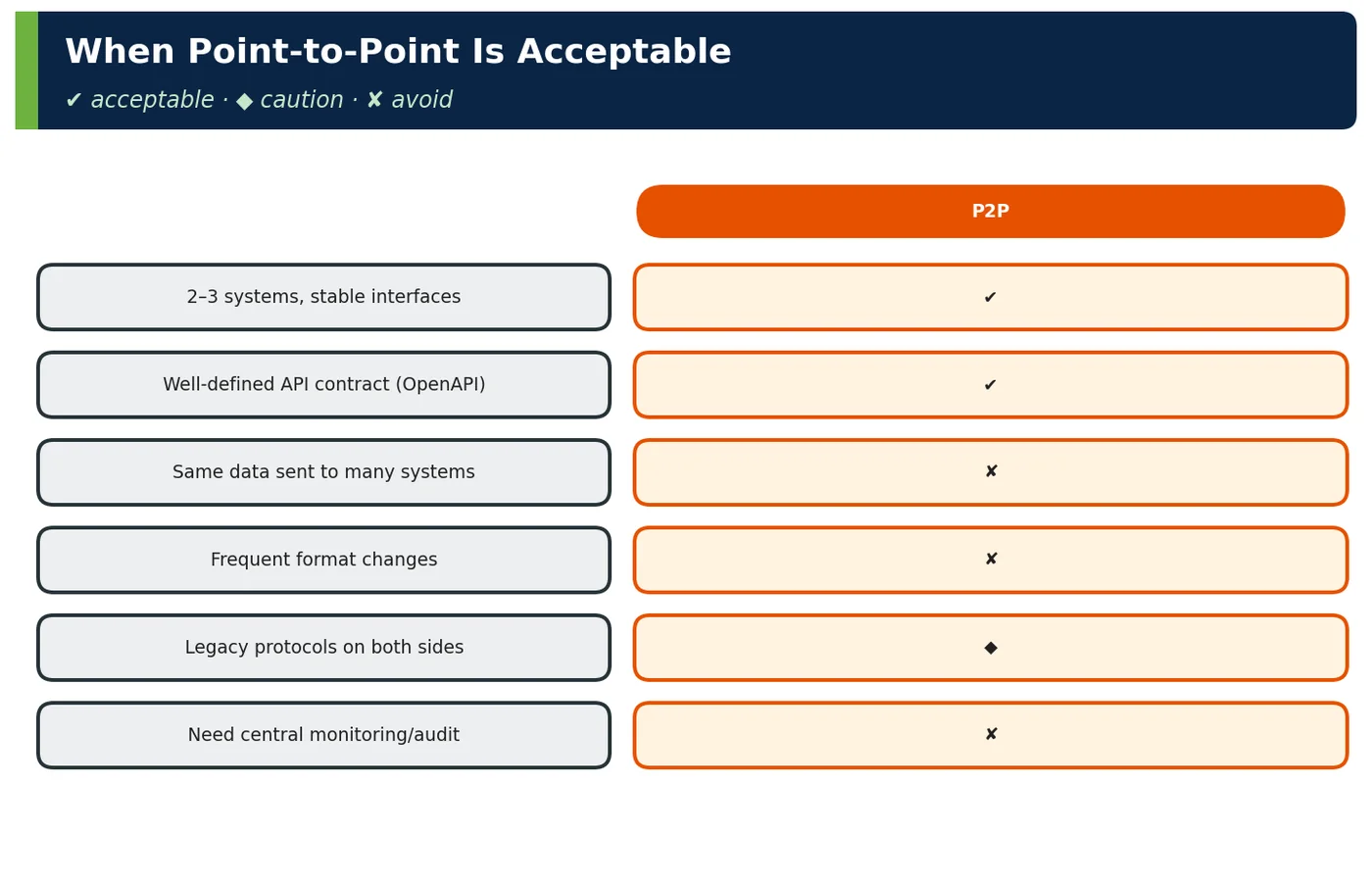
Figure 7 — When point-to-point is acceptable
Case
Why acceptable
Checkout → payment API
One consumer, stable contract, needs sync answer
Two services in same bounded context
Same team owns both
Temporary migration bridge
Time-boxed with exit plan
Table 12 — Direct links aren't evil — unmanaged ones are
6.6 Worked example — hidden database dependencies
SQL
-- Find other applications reading your tables (PostgreSQL)SELECT usename, application_name, count(*)FROM pg_stat_activityWHERE datname = 'shop'GROUP BY usename, application_name;
6.7 Worked example — dependency map from traces
Service
Direct sync dependencies
crm
erp, shop, billing, marketing, bi
shop
crm, pricing, stock, payments
Action
Replace crm fan-out with events
Table 13 — Tracing reveals the real topology
6.8 Worked example — consumer-specific formats
Consumer
Format demanded
Mappings in CRM
ERP
IDoc XML
1
Billing
CSV
1
Shop
JSON v2
1
Marketing
JSON v1
1
Table 14 — With P2P, the producer maintains every consumer's format
6.9 Worked example — security sprawl
Link
Credential
Rotation
CRM → ERP
Shared technical user
Never
ERP → billing SFTP
SSH key
Unknown
BI → shop DB
DB password
2 years old
Table 15 — Each link is an attack surface
6.10 Worked example — governance rule
Rule
Detail
New cross-domain integrations use platform
Events/API gateway
Exceptions via architecture review
Documented reason and expiry
Catalogue entry mandatory
Owner, style, SLA
Table 16 — Preventing new spaghetti
6.11 Worked example — migration progress metric
Quarter
Direct CRM consumers
Via events
Q1
14
0
Q2
9
5
Q3
4
10
Q4
1 (payment exception)
13
Table 17 — Measure untangling
6.12 Worked example — cost of one format change
Landscape
Teams involved
Elapsed time
P2P (6 consumers)
7
6 weeks (coordinated release)
Events + tolerant readers
1
1 day (additive field)
Table 18 — Change cost is the real P2P tax
7Common Problems & Mistakes
Letting every project build its own links without catalogue.
Producer owning consumer formats.
Synchronous P2P chains for propagation.
Direct database access across teams.
No monitoring or ownership per link.
Big-bang replacement instead of incremental migration.
8Performance & Production Considerations
Aspect
Guideline
Visibility
Catalogue and tracing
Coupling
Replace fan-out with pub/sub
Security
Per-link credentials inventory and rotation
Change
Tolerant readers, versioned contracts
Governance
Platform-first rule with exceptions
Table 19 — Operational guidelines
9Architecture & Design Considerations
Accept P2P for few, stable, synchronous needs.
Use mediation (broker, hub, gateway) for shared data and fan-out.
Migrate incrementally, entity by entity.
Keep an integration catalogue current.
10Interview Questions & Answers
Q1BasicConcept
What is point-to-point integration?
Point-to-point integration connects each pair of systems with its own dedicated link, with no intermediary such as a broker, hub or gateway in between. Each link has its own code, data format, protocol, credentials and error handling, chosen by whoever built it. The link can take many forms: a synchronous REST or SOAP call, a CSV dropped into another system's SFTP folder, direct reads from another application's database, a message put on a receiver's private queue, or a vendor SDK embedded in the caller. Each link on its own is simple; the trouble is the unmanaged total, which nobody owns, catalogues or monitors.
Q2BasicConcept
Why is P2P attractive at first?
Because the first link is the cheapest option available. One project team needs data from another system, writes a client or a file export, and delivers in days, with no shared platform to provision, no integration team to queue behind and no new technology to learn. Debugging is easy too, since there is exactly one hop between sender and receiver. For a small number of systems this is often the right call. The cost appears later, when the same shortcut is repeated by many teams over many years: links multiply, formats and transformations are duplicated, and the landscape becomes a web of hidden dependencies nobody fully understands.
Q3IntermediateConcept
What forms of coupling does P2P create?
Each direct link couples the two systems along several dimensions. Location coupling: the sender knows the receiver's host or folder, so moving it breaks the sender. Format coupling: the sender produces exactly the receiver's schema, so any schema change ripples to every sender. Protocol coupling: retiring SOAP or SFTP forces rewrites on the other side. Temporal coupling: with synchronous calls, a receiver outage fails the sender's own operation. Semantic coupling: the meaning of codes such as status=3 is duplicated in every integration and drifts. Together these mean a change in one system triggers coordinated changes, testing and releases in several others, which is the real cost.
Q4IntermediateConcept
How does the number of links scale?
With direct links, each pair of systems can need its own integration, so n systems can require up to n(n−1)/2 links, which grows quadratically: 10 systems can need 45 links, 20 systems 190 and 50 systems 1,225. If links are one-directional and each has its own mapping, the count is worse still. With a mediator such as a broker, hub or event platform, each system connects once, so the number of connections grows linearly with n: 20 systems need 20. The link count matters because every link brings its own mapping, credentials, monitoring and failure mode, so operational cost and change effort scale with links, not systems.
Q5Senior EngineerTricky
Why does the producer often end up owning consumers' formats in P2P?
Because in point-to-point integration the producer sends directly to each consumer, and the consumer was there first with its own interface. ERP wants IDoc XML, billing wants CSV, the shop wants JSON version 2 and marketing still uses version 1, so the producer team ends up writing and maintaining a mapping for every consumer. Every new consumer adds code, testing and release work to a team that gets no benefit from it, and a change to the producer's own model forces updates to every mapping. With publish and subscribe, the producer publishes one owned contract, and each consumer translates into its own model at its own pace, using tolerant readers.
Q6Senior EngineerTrade-off
When is P2P acceptable?
Point-to-point is fine when the number of links stays small and the reasons are explicit. Typical good cases are a genuinely synchronous need with one consumer and a stable contract, such as checkout calling a payment API for an immediate authorisation; two services in the same bounded context owned by one team, who can change both together; and a temporary bridge during migration, time-boxed with a documented exit plan. The condition is that the link is managed: registered in the integration catalogue with an owner, a versioned contract, monitoring and credentials that are rotated. Direct links are not the problem; unmanaged, untracked ones that multiply over time are.
Q7Technical ArchitectScenario
How do you discover hidden P2P dependencies?
Combine several sources, because no single one sees everything. Distributed tracing with OpenTelemetry gives a service graph of synchronous calls that actually happen. Network flow logs and firewall rules reveal connections from systems without tracing, including legacy ones. Database session audits, such as grouping pg_stat_activity by user and application_name, plus grant reviews, expose other applications reading your tables. Code and configuration searches for host names, client libraries and SFTP paths find batch and file integrations, and the credential inventory shows which technical users and keys exist. Record every finding in a catalogue such as Backstage with an owner and protocol, and keep refreshing it from tracing data.
Q8Solution ArchitectDesign
How would you migrate a spaghetti landscape?
Incrementally, entity by entity, never with a big-bang rewrite. First discover and catalogue every link with owner, style and criticality. Then prioritise the entities with the most consumers, usually customer, product and order. For each one, the source system publishes a single owned contract, for example a CustomerChanged event on Kafka or an API behind a façade. Migrate consumers one at a time onto that contract, then remove the direct link and revoke its credentials. Track progress with a visible metric such as direct consumers per entity per quarter. Finally, govern new work: cross-domain integrations must use the platform, with exceptions requiring architecture review and an expiry date.
Newsletter
Get new tutorials every week
New ArchitectMind tutorials and interview questions, once a week. No spam, unsubscribe anytime.
Your subscription could not be saved. Please try again.
Almost done! Check your inbox and click the confirmation link to complete your subscription.
 Architect