 Architect

- Prerequisites
- 1.1 Generic Types
- Covers
- Type safety · Reusability · Compile-time checking
- Related
- 3.1 Why Type Erasure Exists · 3.3 Restrictions
On this page
1Concept / Definition
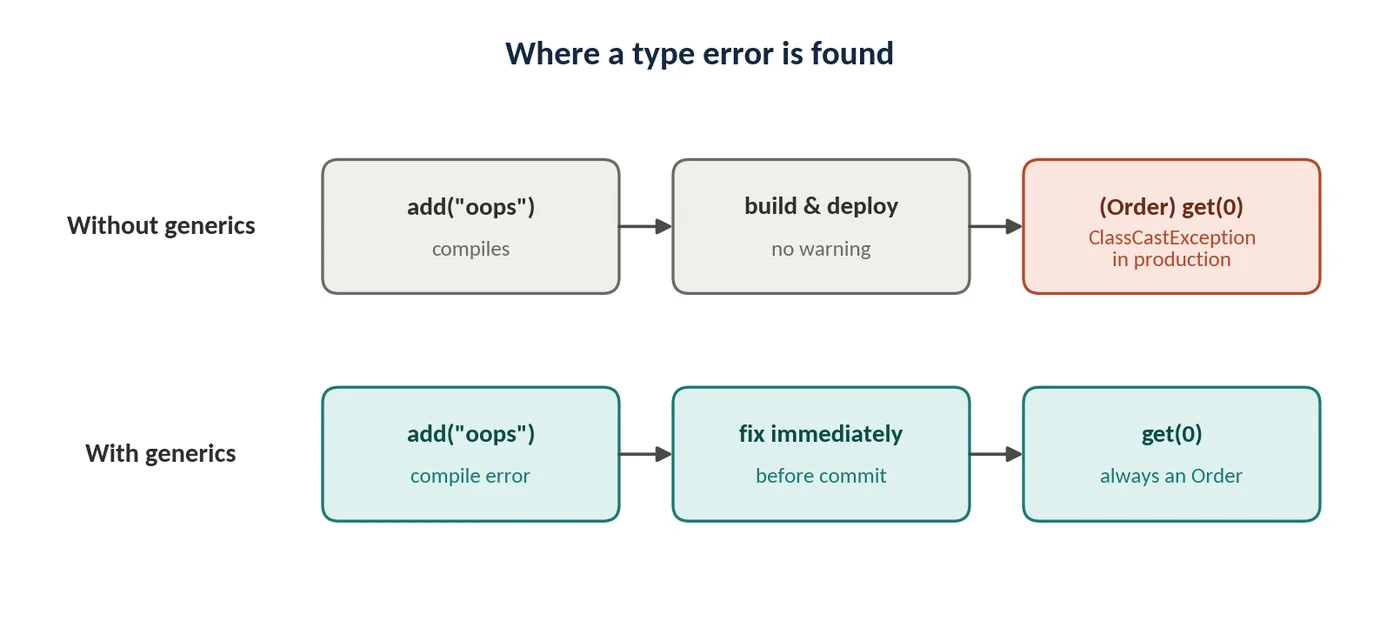
Generics give Java three linked benefits: type safety (a container holds only what it declares), reusability (one implementation for all types) and compile-time checking (mistakes are caught by javac rather than in production). All three come from the compiler knowing, at each use site, the actual types involved.
2Why It Exists
Until Java 5, every collection stored Object. A method that returned a List told the caller nothing about what was inside it, so the knowledge lived in comments, naming conventions and the developer's memory. Every read needed a cast, and every cast was a bet that some other piece of code had inserted the right kind of object. When the bet failed, the ClassCastException appeared at the read, often in a different class, thread or release from the faulty write, which made these bugs slow to trace.
The alternatives were no better. Writing a separate OrderList, CustomerList and InvoiceList gave safety but multiplied code, tests and defects. Generics, added by JSR 14 in Java 5, solved both problems at once: the type is declared once at the use site, the compiler enforces it everywhere, and a single library implementation serves every element type. Because the design used erasure, existing raw code and binaries kept working, which let the whole ecosystem migrate gradually rather than in one step.
3Core Concepts
Type safety
A List<Order> can only receive Order objects (or subtypes) and only returns Order. The compiler inserts the casts that raw code needed and guarantees they succeed — provided there are no unchecked warnings. This is the heap pollution guarantee: if code compiles without unchecked warnings, generic casts inserted by the compiler cannot fail.
Reusability
One ArrayList<E>, one HashMap<K, V>, one Collections.sort serve every type. Without generics, the choice was between unsafe Object-based code and duplicating classes per type (OrderList, CustomerList). Generic algorithms such as max, binarySearch and stream operations are written once and checked for each use.
Compile-time checking
Errors move to the earliest and cheapest point: the compiler and the IDE. Generic signatures also act as documentation — Map<CustomerId, List<Order>> says more than Map. The checking happens only at compile time; at run time most type arguments are erased (Chapter 3), which is why warnings about unchecked operations must be taken seriously.
4How It Works Internally
What javac checks
For every use of a parameterised type, the compiler substitutes the type arguments into the member signatures. On a List<Order>, add is checked as add(Order) and get as returning Order. Assignments, method arguments and return values are verified against these substituted types, and inference fills in arguments the code omits, such as the diamond in new ArrayList<>() or the T of a generic method call.
Inserted casts and bridge methods
After checking, javac erases type arguments and inserts a checkcast instruction wherever a generic value is used as its specific type, so Order o = list.get(0) compiles to a call returning Object followed by a cast to Order. When a class implements a generic interface, for example Comparable<Order>, the compiler also generates a synthetic bridge method compareTo(Object) that casts and delegates to compareTo(Order), so erased callers still reach the right code.
When the guarantee breaks
Those inserted casts are guaranteed to succeed only if every operation was type-checked. Raw types, unchecked casts such as (List<Order>) obj, and generic varargs let the compiler accept code it cannot prove safe, and each one produces an unchecked warning. If such code stores the wrong object, nothing fails at that point; the failure comes later, at a compiler-inserted cast in code that looks perfectly correct.
5APIs / Features / Syntax
Most of the benefit comes from a few language features and compiler options:
// Diamond: type arguments inferred from the target
Map<CustomerId, List<Order>> byCustomer = new HashMap<>();

// Generic method: written once, checked at every call
static <T extends Comparable<? super T>> T max(Collection<T> items) {
    return Collections.max(items);
}

// Local, justified suppression on the smallest scope
@SuppressWarnings("unchecked") // safe: array only ever holds E
E[] elements = (E[]) new Object[capacity];

// Run-time guard at a boundary with legacy or untrusted code
List<Order> guarded = Collections.checkedList(new ArrayList<>(),
Order.class);# Show each unchecked operation and fail the build on any warning
javac -Xlint:unchecked -Xlint:rawtypes -Werror ...
# Maven: maven-compiler-plugin <compilerArgs> with the same flags@SafeVarargs marks a generic varargs method as not polluting its array, and Collections.checkedList, checkedMap and friends add a run-time type check on insertion, which is useful when a collection is handed to code that was compiled without generics.
6Practical Examples
// Raw: compiles, fails later
List orders = new ArrayList();
orders.add(new Order(1));
orders.add("not an order");                  // accepted
for (Object o : orders) {
    Order order = (Order) o;  // ClassCastException on 2nd element
}

// Generic: rejected at compile time
List<Order> typed = new ArrayList<>();
typed.add("not an order");                    // error: incompatible types
The raw version compiles because List accepts any Object; the error surfaces only when the loop casts the second element. The generic version moves the same mistake to the line that caused it, with a compiler message that names both types.
Example 2 — Reuse instead of duplication
// Before: one copy per type, or Object and casts
static Order newestOrder(List<Order> orders) { ... }
static Invoice newestInvoice(List<Invoice> invoices) { ... }

// After: one implementation, type-checked for every caller
interface Dated { Instant createdAt(); }

static <T extends Dated> Optional<T> newest(List<T> items) {
    return items.stream()
            .max(Comparator.comparing(Dated::createdAt));
}

Optional<Order> o = newest(orders);     // returns Order, no cast
Optional<Invoice> i = newest(invoices); // returns Invoice
The bound T extends Dated lets the method call createdAt() while still returning the caller's exact type, which an Object-based version could not do without a cast at every call site.
Example 3 — Heap pollution through a raw type
List<String> names = new ArrayList<>();
List raw = names;          // warning: raw type
raw.add(42);               // warning: unchecked call; no failure here

// ... much later, in code with no warnings at all
String first = names.get(0);  // ClassCastException: Integer -> String
The line that throws is innocent; the bug is two lines earlier. This is why the safety guarantee is stated conditionally, and why the warnings matter more than they appear to.
7Common Problems & Mistakes
Ignoring unchecked warnings. Teams let hundreds accumulate, and the one that matters becomes invisible. Fix or justify each warning, and keep the count at zero.
Suppressing too broadly. @SuppressWarnings("unchecked") on a class hides every future problem in it. Put it on the single variable declaration, with a comment explaining why the cast is safe.
Raw types in new code. Writing List or Comparable without arguments, often from old tutorials or IDE autocompletion, switches off checking for that variable entirely.
Trusting generics across a boundary. Data deserialised from JSON, read by reflection or returned by legacy libraries has not been checked by your compiler. Validate it, or use type tokens such as Jackson's TypeReference, before treating it as a List<Order>.
Over-generic APIs. Making every class generic in pursuit of reuse produces signatures that are hard to read and infer. Reuse pays off for infrastructure, not for every domain class.
8Performance & Production Considerations
The benefits are free at run time. Erasure means generic code produces the same bytecode as hand-written Object code with casts, and the JIT removes most checkcast instructions when it can prove the type. There is no per-type code duplication, unlike C++ templates, so class files and memory stay small.
The costs that do appear in production are indirect. Type arguments must be reference types, so List<Integer> boxes every value; in large collections or hot loops, prefer int[], IntStream or a primitive collection library. Heap pollution shows up as a ClassCastException with a stack trace that points to the wrong place; when you see one at a line that looks type-safe, search for raw types, unchecked casts and deserialisation feeding that collection. Build pipelines that fail on unchecked warnings stop these defects before they ship.
9Architecture & Design Considerations
Generic types are a cheap way to put intent into contracts. A signature such as Map<CustomerId, List<Order>> or Result<Payment, PaymentError> documents itself, and strongly typed identifiers such as CustomerId instead of String stop whole categories of mix-ups across service layers. Shared libraries gain the most: one tested repository, cache, event envelope or paging wrapper serves every team and every domain type.
At system boundaries the guarantees stop, because JSON, message payloads and database rows are untyped until your code checks them. Design those edges explicitly: map external data into typed records in one place, validate it, and let generic types carry the guarantee inward from there. Make a zero-unchecked-warnings build a team standard, since the compile-time guarantee is only as strong as the weakest module that ignores it.
10Interview Questions & Answers
What are the main benefits of generics?
Generics give three linked benefits. Type safety: a List<Order> accepts and returns only orders, and the compiler inserts the casts and guarantees they succeed. Reusability: one implementation, such as ArrayList, HashMap or Collections.sort, serves every type instead of duplicating code per type or falling back to Object. Compile-time checking: type mistakes are reported by javac and the IDE at the line that causes them, not as a ClassCastException in production. A fourth, often overlooked benefit is documentation, because Map<CustomerId, List<Order>> explains itself far better than a raw Map. All of this comes at no run-time cost, since type arguments are erased after checking.
Do generics add run-time type checks?
No. Generics are a compile-time mechanism. javac checks the code, erases most type arguments and inserts ordinary checkcast instructions where a generic value is used as its specific type, so List<Order>.get becomes a call returning Object followed by a cast to Order. Those casts existed in pre-generics code too; generics just make the compiler write them and prove they succeed. There is no check when an element is added, which is why a raw type or unchecked cast can sneak in a wrong object without any error at that point. If you need a run-time guard, for example at a legacy boundary, wrap the collection with Collections.checkedList.
What is heap pollution?
Heap pollution is when a variable of a parameterised type refers to an object that is not of that type, for example a List<String> that actually contains an Integer. It can only happen through operations the compiler flags as unchecked: raw types, unchecked casts, generic varargs arrays or reflection. Nothing fails when the wrong object is inserted. The failure comes later, as a ClassCastException at a compiler-inserted cast in code that looks completely type-safe, often in another class or thread. The cure is preventive: eliminate raw types, justify every unchecked cast, mark safe generic varargs methods with @SafeVarargs, and validate data from deserialisation before trusting it.
Why should a team treat unchecked warnings as errors?
Because the compile-time safety guarantee is conditional: compiler-inserted casts are proven safe only if the code compiles without unchecked warnings. Each ignored warning is a place where a wrong object can enter a collection silently and later throw a ClassCastException somewhere unrelated, which is expensive to debug in production. Once a build shows dozens of warnings, nobody notices the new dangerous one. So the build should run with -Xlint:unchecked and -Werror, or an equivalent compiler plugin setting. Genuine cases, such as creating a generic array inside a collection class, are suppressed on the smallest possible declaration with a comment explaining why the cast is safe.
Key Takeaways
- Generics give type safety, reuse and compile-time checking.
- Casts are inserted by the compiler and guaranteed safe if there are no unchecked warnings.
- Checking is compile-time only; treat unchecked warnings seriously.
Coverage checklist
Type safety ✔ · Reusability ✔ · Compile-time checking ✔