 Architect

On this page
- 1. · Concept & Definition
- 2. · Why It Matters
- 3. · How It Works
- 4. · Java / Jakarta EE Code Examples
- 5. · Configuration, Defaults & Diagnostics
- Deep Dive — Inheritance Mapping Strategies
- Deep Dive — Providers and Portability
- 6. · Production Usage Patterns
- 7. · Common Pitfalls & Misconceptions
- 8. · Best Practices
- 9. · Architect's Perspective & Trade-offs
- 10. · Interview Q&A
1· Concept & Definition
Object/relational mapping (ORM) is the technique of representing rows of relational tables as objects of a domain model and keeping the two synchronised automatically. Jakarta Persistence is the Jakarta EE standard API for ORM: applications annotate classes as entities, and a persistence provider generates the SQL needed to load, insert, update and delete them, tracks changes to loaded objects and translates object-oriented queries into SQL.
| Term | Meaning |
|---|---|
| Entity | A class whose instances correspond to rows of a table, with a persistent identity |
| Persistence provider | The implementation (Hibernate, EclipseLink) that generates and executes SQL |
| Persistence unit | A named set of entity classes plus a data source and provider configuration |
| EntityManager | The API through which the application manipulates entities |
| Persistence context | The set of entity instances managed by an EntityManager at a given time |
| Dialect | Provider configuration describing the SQL flavour of the target database |
2· Why It Matters
- ORM removes most hand-written CRUD SQL and mapping code, which is where a large share of defects used to live.
- It provides a single place for transactional write behaviour: change tracking, ordering of statements, optimistic locking.
- Its abstractions hide the database just enough to be dangerous: the SQL still exists, and architects must be able to predict it.
- The mapping choices made early (identity, associations, fetch types, inheritance) are expensive to change later.
3· How It Works
Impedance mismatch
The object/relational impedance mismatch is the set of structural differences between an object model and a relational schema. ORM does not remove these differences; it provides a systematic translation, and every translation has a cost that shows up somewhere — usually as extra queries, surprising updates or constraints on how the domain model may be written.
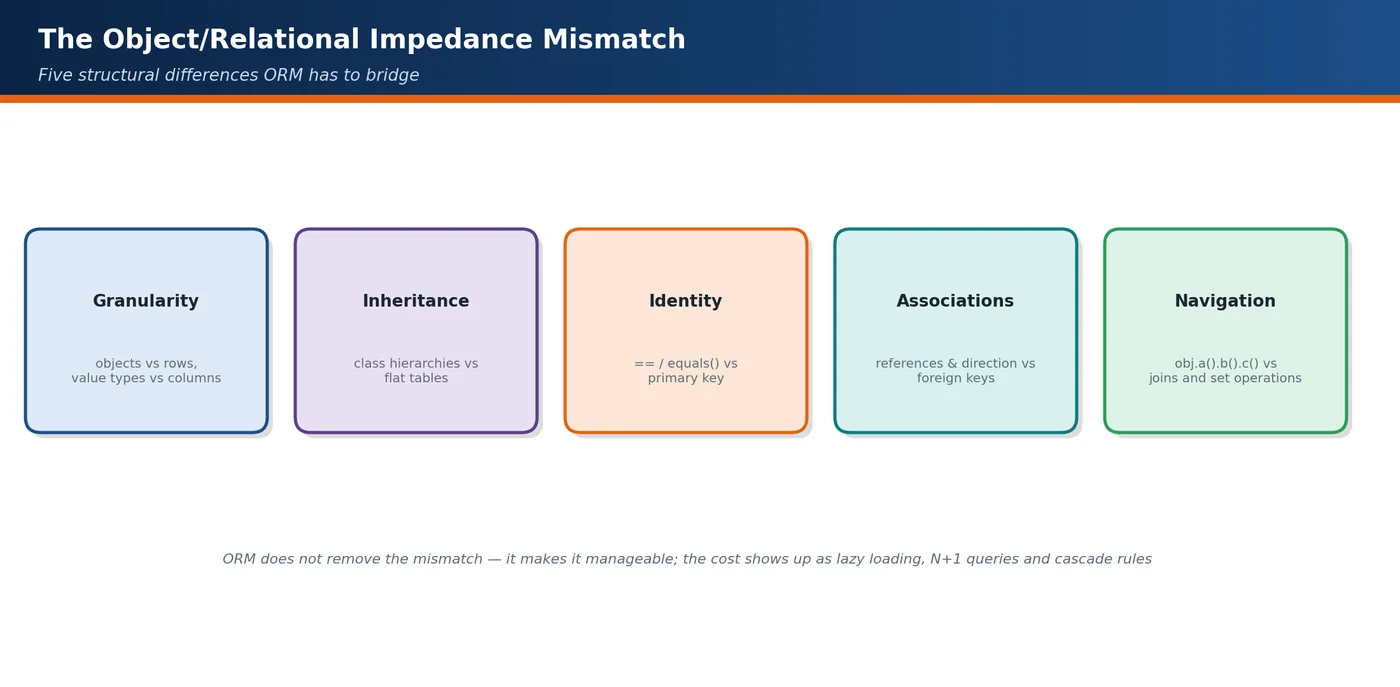
| Dimension | Object model | Relational model | ORM answer |
|---|---|---|---|
| Granularity | Many small classes, value objects | Fewer, wider tables | @Embeddable value types, @Convert |
| Inheritance | Class hierarchies, polymorphism | No native inheritance | SINGLE_TABLE, JOINED, TABLE_PER_CLASS |
| Identity | == and equals() | Primary key | Identity map per context, @Id |
| Associations | Directed references, collections | Foreign keys (bidirectional by nature) | Owning/inverse sides, join tables |
| Navigation | order.getCustomer().getAddress() | Joins and set operations | Lazy loading, fetch joins, entity graphs |
| Data retrieval | Walk the graph | Select the columns you need | Projections, DTOs, entity graphs |
ORM concepts
| Concept | What it gives you | What to watch |
|---|---|---|
| Transparent persistence | Changes to loaded objects are written automatically | Unintended updates from accidental setters |
| Unit of work | Statements are collected and executed at flush | Timing of SQL differs from the code order |
| Identity map | One instance per PK per context | Instances differ across contexts |
| Lazy loading | Load only what is traversed | LazyInitializationException, N+1 queries |
| Object query language | Query the model, not tables | Generated SQL may not be the one you'd write |
| Caching | First-level (context) and optional second-level | Staleness, invalidation in clusters |
Mapping
Mapping declares how classes, fields and associations correspond to tables, columns and foreign keys. In Jakarta Persistence it is expressed with annotations on entity classes (or in an XML mapping file, which overrides annotations — useful when the same classes must map differently per deployment).

| Mapping area | Main annotations |
|---|---|
| Entity and table | @Entity, @Table, @SecondaryTable, @Index, @UniqueConstraint |
| Identity | @Id, @GeneratedValue, @EmbeddedId, @IdClass |
| Basic fields | @Basic, @Column, @Enumerated, @Lob, @Convert, @Transient |
| Value objects | @Embeddable, @Embedded, @AttributeOverride |
| Associations | @ManyToOne, @OneToMany, @OneToOne, @ManyToMany, @JoinColumn, @JoinTable |
| Inheritance | @Inheritance, @DiscriminatorColumn, @MappedSuperclass |
| Concurrency | @Version |
4· Java / Jakarta EE Code Examples
@Entity
@Table(name = "orders",
       uniqueConstraints = @UniqueConstraint(name = "uk_order_number",
               columnNames = "order_number"))
public class Order {

    @Id @GeneratedValue(strategy = GenerationType.SEQUENCE, generator = "order_seq")
    @SequenceGenerator(name = "order_seq", sequenceName = "order_seq",
            allocationSize = 50)
    private Long id;

    @Column(name = "order_number", nullable = false, updatable = false, length = 20)
    private String orderNumber;

    @Enumerated(EnumType.STRING) @Column(nullable = false, length = 20)
    private OrderStatus status = OrderStatus.NEW;

    @Embedded
    // value object → columns in orders
    private Money total;

    @Column(name = "created_at", nullable = false, updatable = false)
    private Instant createdAt = Instant.now();

    @Version
    private long version;                                  // optimistic locking
    // getters/setters …
}

@Embeddable
public record Money(@Column(name = "total_amount") BigDecimal amount,
@Column(name = "total_currency", length = 3) String currency) { }<!-- META-INF/persistence.xml -->
<persistence xmlns="https://jakarta.ee/xml/ns/persistence" version="3.2">
<persistence-unit name="shopPU" transaction-type="JTA">
<jta-data-source>java:app/jdbc/shop</jta-data-source>
<properties>
<property name="jakarta.persistence.schema-generation.database.action"
value="none"/>
<property name="hibernate.jdbc.batch_size" value="50"/>
<property name="hibernate.order_inserts" value="true"/>
<property name="hibernate.order_updates" value="true"/>
</properties>
</persistence-unit>
</persistence>// Jakarta Persistence 3.2: bootstrapping programmatically (useful in tests and Java SE)
EntityManagerFactory emf = new PersistenceConfiguration("shopPU")
.provider("org.hibernate.jpa.HibernatePersistenceProvider")
.managedClass(Order.class)
.property("jakarta.persistence.jdbc.url", "jdbc:h2:mem:test")
.createEntityManagerFactory();Hibernate: insert into orders
(created_at,order_number,status,total_amount,total_currency,version,id)
values (?,?,?,?,?,?,?)
Hibernate: update orders set status=?, version=? where id=? and version=?5· Configuration, Defaults & Diagnostics
| Property | Typical value | Purpose |
|---|---|---|
jakarta.persistence.schema-generation.database.action | none in production | Schema creation is a migration-tool job (Flyway/Liquibase) |
jakarta.persistence.sql-load-script-source | test data script | Seeding in tests |
hibernate.jdbc.batch_size | 20–100 | JDBC batching of inserts/updates |
hibernate.order_inserts / order_updates | true | Groups statements so batching is effective |
hibernate.generate_statistics | true in test/perf | Query and entity counters |
| SQL logging | org.hibernate.SQL at DEBUG | See the statements actually issued |
Deep Dive — Inheritance Mapping Strategies
Class hierarchies are the sharpest part of the impedance mismatch, and the chosen strategy shows up directly in query plans.
| Strategy | Schema | Strengths | Weaknesses |
|---|---|---|---|
SINGLE_TABLE (default) | One table, discriminator column | Fastest (no joins), simple polymorphic queries | Subclass columns must be nullable; wide table |
JOINED | Table per class, joined by PK | Normalised, NOT NULL constraints possible | Joins on every read; slower polymorphic queries |
TABLE_PER_CLASS | One table per concrete class | No joins for concrete reads | Polymorphic queries become UNIONs; identity must be shared |
@MappedSuperclass | No table for the base class | Shares mapped fields only | Not polymorphic; cannot be queried as a type |
@Entity
@Inheritance(strategy = InheritanceType.SINGLE_TABLE)
@DiscriminatorColumn(name = "payment_type", length = 20)
public abstract class Payment {
    @Id @GeneratedValue private Long id;
    private BigDecimal amount;
}

@Entity @DiscriminatorValue("CARD")
public class CardPayment extends Payment { private String maskedPan; }

@Entity @DiscriminatorValue("UPI")
public class UpiPayment extends Payment { private String vpa; }

// SELECT p FROM Payment p  →  one SELECT with "where payment_type in ('CARD','UPI')"
Deep Dive — Providers and Portability
| Aspect | Standard (Jakarta Persistence) | Provider extension |
|---|---|---|
| Batching | not specified | hibernate.jdbc.batch_size, EclipseLink batch writing |
| Second-level cache | @Cacheable, shared-cache-mode | Region configuration, providers (Infinispan, EHCache) |
| Statistics | not specified | Hibernate Statistics, EclipseLink profiler |
| Multi-tenancy | not specified | Hibernate tenant resolver strategies |
| Soft deletes, filters | not specified | Hibernate @SoftDelete, @Filter |
Portable code should keep provider-specific features behind configuration and a small number of clearly marked classes, so that an upgrade or provider change does not ripple through the domain model.
6· Production Usage Patterns
- Entities used as the write model, with DTO projections for read-heavy endpoints.
- Schema managed by migrations; the mapping validated against it at build or startup (
validate). - A thin repository layer over
EntityManager, or Jakarta Data repositories (Chapter 7). - Integration tests running against the real database engine (Testcontainers) rather than an in-memory substitute.
7· Common Pitfalls & Misconceptions
- Treating entities as DTOs and exposing them directly in APIs — lazy loading and serialisation problems.
- Letting the provider generate the schema in production instead of versioned migrations.
- Assuming ORM makes SQL irrelevant — the generated statements decide performance.
- Mapping every table even when a read-only query or a simple JDBC call would do.
@Enumerated(ORDINAL)(the default!) — adding an enum constant silently changes stored meanings.
8· Best Practices
- Keep the domain model and schema evolving together through migrations, with mapping validation in CI.
- Always specify
@Enumerated(EnumType.STRING)and explicit column definitions for important fields. - Log and review generated SQL during development; count statements in tests.
- Use value objects (
@Embeddable) to keep the model expressive without extra tables.
9· Architect's Perspective & Trade-offs
| Approach | Strengths | Weaknesses | Fits |
|---|---|---|---|
| Jakarta Persistence (ORM) | Transparent writes, portability, rich model | Hidden SQL, learning curve | Transactional domain logic |
| SQL mapper (MyBatis, JDBI) | Full SQL control, predictable | Manual mapping, no change tracking | Report-heavy, legacy schemas |
| Plain JDBC / jOOQ | Maximum control, type-safe SQL (jOOQ) | More code, no unit of work | Bulk operations, analytics |
| Jakarta Data repositories | Less boilerplate over JPA | Still JPA underneath | CRUD and simple queries |
10· Interview Q&A
What is object/relational mapping?
Object-relational mapping is a technique for storing and loading objects in a relational database without writing SQL by hand for every operation. Classes are mapped to tables, fields to columns and associations to foreign keys, usually through annotations such as @Entity, @Id and @ManyToOne. The ORM provider generates SQL, tracks changes to loaded objects and writes them back at commit. In Jakarta EE the standard API is Jakarta Persistence, implemented by providers such as Hibernate and EclipseLink. ORM removes a lot of repetitive data-access code, but developers still need to understand the SQL it produces to avoid performance problems.
What is a persistence unit?
A persistence unit is a named configuration that tells Jakarta Persistence which entity classes to manage, which data source to use and which provider and properties apply. Traditionally it is declared in META-INF/persistence.xml; Jakarta Persistence 3.2 also allows it to be defined programmatically. The application server or framework uses it to create an EntityManagerFactory, from which EntityManager instances are obtained. An application can have several persistence units, for example one per database. In Spring Boot the persistence unit is usually configured automatically from properties, but the concept is the same.
What is the impedance mismatch?
The impedance mismatch is the set of structural differences between object models and relational schemas. Objects can be fine-grained, while tables group many values into rows. Objects use inheritance; tables have none. Objects have identity, equality and references, while rows have primary keys and foreign keys. Objects navigate associations by following references; databases use joins. An ORM translates between the two worlds, but it cannot remove the differences. They still influence design decisions, such as choosing an inheritance mapping strategy, and performance, such as lazy loading causing N+1 queries when an object graph is traversed carelessly.
Why is @Enumerated(EnumType.STRING) recommended?
By default, an enum field is stored as its ordinal, its position in the enum declaration. If someone later inserts a new constant in the middle or reorders constants, existing rows silently take on a different meaning: an order stored as 2, meaning SHIPPED, might suddenly read as CANCELLED. @Enumerated(EnumType.STRING) stores the constant's name instead, which is stable when constants are added or reordered, and readable when querying the database directly. Renaming a constant still requires a data migration. For more control, a JPA AttributeConverter can map enums to explicit codes, which also keeps database values independent of Java names.
How do you keep control over the SQL an ORM generates?
Make the SQL visible and testable. During development, enable SQL logging with bind parameters and the provider's statistics, so you can see how many statements each use case runs. In integration tests, assert statement counts for important use cases, so an accidental N+1 query fails the build. Compare generated DDL against the migration scripts. In code, choose fetch strategies deliberately: use fetch joins or entity graphs where related data is needed, projections or DTO queries for read-only views, and JDBC batching for bulk inserts and updates. In production, monitor slow queries at the database level.
When would you not use JPA for a piece of functionality?
JPA is designed for loading, changing and saving entities in transactional use cases. It is a poor fit for bulk, set-based operations such as updating a million rows, where loading each entity is wasteful; for reporting queries with heavy aggregation and many joins; and for database-specific features such as window functions, recursive queries or stored procedures. For these, use native SQL, a query library such as jOOQ, or database-side code, often alongside JPA in the same application. The key is to choose per use case and keep the boundary clear, so each part uses the tool that fits.
How should schema evolution be managed in a JPA application?
Treat the database schema as code with its own history. Write versioned migration scripts with Flyway or Liquibase and make them the single source of truth; they run automatically at deployment, in the same order in every environment. Disable the provider's automatic schema generation in all shared environments, because it cannot handle data migrations or renames safely. Use the provider's validation mode or integration tests to check that entity mappings match the migrated schema, so mismatches fail early. For zero-downtime deployments, design migrations in expand-and-contract steps so old and new application versions can run against the same schema.
What architectural risks does ORM introduce in large systems?
The first risk is hidden cost: an innocent-looking navigation through an object graph can trigger hundreds of queries, so latency and database load grow unseen until production traffic arrives. The second is coupling: a large entity model shared across many teams or bounded contexts becomes a place where everyone's changes collide, much like a shared database. The third is scalability: a model designed for convenience can force chatty access patterns that are hard to optimise later. Mitigate them with per-use-case queries and DTOs, separate models per bounded context, measured SQL in tests, and clear guidance on when to bypass the ORM.